The Critical Role of Precision Bores in Hydraulic Systems
In the world of hydraulic cylinder manufacturing, the internal surface of the cylinder barrel is not merely a passage—it is the functional heart of the entire system. The performance, service life, and reliability of any hydraulic cylinder tube depend almost entirely on the geometric accuracy and surface integrity of its inner diameter (ID). For engineers and procurement specialists sourcing precision steel tubes, understanding the nuances of bore finishing processes is essential to making informed decisions that impact total lifecycle costs.
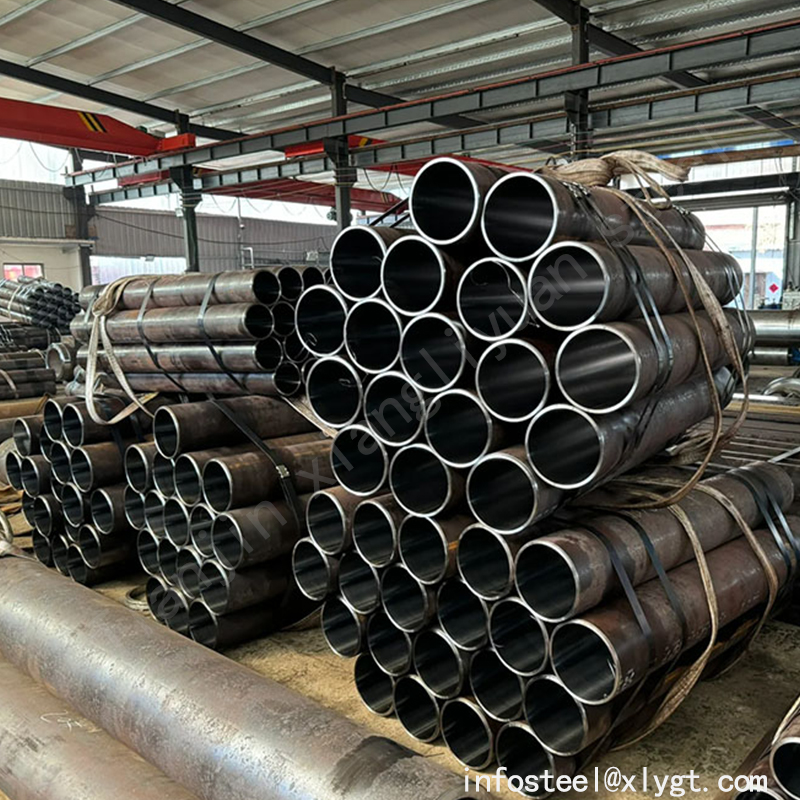
At Tianjin Xiangliyuan Steel, we have specialized in the production of honed tubes, SRB tubes, and cold drawn seamless tubes for over a decade. Located in the port city of Tianjin, we offer unique logistical advantages for global shipments while maintaining technical standards that meet and exceed international requirements. This article provides a comprehensive, technically rigorous comparison of the three primary manufacturing processes for high-precision cylinder barrels: deep hole boring, honing, and skiving & roller burnishing (SRB) .
Raw Material Preparation – The Foundation of Quality
Before any bore finishing operation begins, the quality of the starting material determines the上限 of what can be achieved. All precision hydraulic cylinder tubes begin as either hot rolled seamless (HRS) tubes or cold drawn seamless (CDS) tubes .
Cold drawn seamless tubes are generally preferred for high-end applications because the cold drawing process itself improves mechanical properties through strain hardening. The process involves:
-
Pickling and phosphatization: Removing scale and applying a lubricant-friendly coating
-
Saponification: Creating a metallic soap layer to facilitate drawing
-
Multiple cold drawing passes: Reducing diameter and wall thickness while increasing length and tensile strength
Following cold drawing, the tubes undergo stress relieving annealing to eliminate residual stresses while maintaining enhanced mechanical properties. This heat treatment step is critical—raw tubes with unstable metallurgy will distort during subsequent honing or SRB operations, rendering them out of spec .
At Tianjin Xiangliyuan Steel, we maintain strict control over our raw material supply chain, sourcing only certified steel grades including ST52, E355, 1026, and 1045 to ensure consistency before any bore finishing begins.
Deep Hole Boring – Establishing the Primary Bore
2.1 Process Principles
Deep hole boring (also known as gundrilling or BTA drilling depending on diameter and depth ratios) is the foundational process for creating cylinder tubes from hot rolled or as-rolled hollows. This process is necessary when the starting tube’s ID is either too rough or too small to directly accept honing or SRB tooling.
The deep hole boring process utilizes a single-edged cutting tool mounted on a long boring bar. High-pressure coolant is delivered through the tool to:
-
Flush chips away from the cutting zone
-
Maintain dimensional stability by controlling thermal expansion
-
Lubricate the cutting edge for improved surface finish
2.2 Technical Capabilities
| Parameter | Typical Range |
|---|---|
| Bore diameter tolerance | IT9 to IT11 |
| Surface roughness (Ra) | 1.6 – 6.3 μm |
| Straightness | 0.5 – 1.0 mm/m |
2.3 Limitations for Final Applications
While deep hole boring creates a straight, round bore, the resulting surface is too rough for direct use with hydraulic piston seals. The characteristic spiral feed marks and torn metal fibers would rapidly destroy seal materials and allow bypass leakage. Therefore, bored tubes always require secondary finishing operations.
Honing – The Traditional Standard for Precision Cylinder Tubes
3.1 Process Description
Honing is an abrasive machining process that has been the industry standard for hydraulic cylinder honed tubes for decades. The process employs a set of expandable abrasive stones (typically aluminum oxide, silicon carbide, or CBN – cubic boron nitride) mounted on a honing head that simultaneously rotates and reciprocates within the bore .
The characteristic cross-hatch pattern created by the interaction of rotational and reciprocating motions is not a cosmetic feature—it serves a critical functional purpose. The cross-hatch acts as an oil reservoir, trapping hydraulic fluid to maintain lubrication between the piston seal and the cylinder wall throughout each stroke cycle .
3.2 The Honing Process Steps
A typical honing operation for precision seamless tubes follows this sequence:
-
Coarse honing: Removing the remaining boring stock (0.10 – 0.30 mm) to establish basic geometry
-
Medium honing: Reducing surface roughness to approximately Ra 0.4 – 0.8 μm
-
Fine honing: Achieving final dimensions and surface finish
-
Brush honing (optional): Removing burrs from cross-holes or ports
3.3 Technical Specifications Achievable
-
Diameter tolerance: H7, H8, or H9 depending on equipment (typical: 0.02 – 0.05 mm)
-
Roundness: 0.005 – 0.015 mm
-
Straightness: 0.05 – 0.15 mm/m
-
Surface roughness (Ra): 0.2 – 0.4 μm
-
Surface roughness (Rz): 1.0 – 3.0 μm
3.4 Advantages of Honing
-
Geometric correction: Honing effectively corrects ovality, taper, and waviness from previous operations
-
Material versatility: Can process virtually any material, including hardened steels, stainless steel, and even some non-ferrous alloys
-
Oil retention: The cross-hatch pattern provides predictable lubricant retention characteristics
3.5 Limitations
The primary limitation of conventional honing is processing speed. Honing is a low material removal rate (MRR) process. Production rates typically range from 10 to 30 minutes per meter of tube length, depending on starting condition and required tolerances. For high-volume production of honed cylinder tubes, this translates to significant labor and machine time costs.
Skiving & Roller Burnishing (SRB) – The High-Efficiency Alternative
4.1 Process Overview
Skiving and roller burnishing (SRB) , also known as skive burnishing or combined boring and burnishing, is a two-stage, single-pass process that has gained significant adoption in global hydraulic cylinder tube manufacturing .
Unlike honing, which uses loose abrasives, SRB uses a fixed cutting edge followed by precision rollers to achieve its final surface.
4.2 The SRB Process Sequence
Stage One: Skiving (Forward Stroke)
The skiving tool passes through the bore at a programmed feed rate (typically 1 – 4 mm/rev) . The tool incorporates multiple cutting edges (typically 2-6 blades) that remove a thin chip layer—usually 0.15 – 0.35 mm of stock. This skiving operation establishes:
-
Final bore diameter with IT8 tolerance capability
-
Straightness that follows the existing bore path
-
A surface finish of approximately Ra 4 – 10 μm
Stage Two: Roller Burnishing (Reverse Stroke)
After the skiving tool reaches the end of the bore, the machine retracts the skiving blades and engages the roller burnishing section of the tool. As the tool withdraws, hardened rollers (typically 3-6 rollers) are hydraulically or mechanically expanded against the bore surface.
Roller burnishing is not a cutting process—it is a cold working operation. The rollers plastically deform the surface peaks into the valleys, achieving:
-
Surface roughness as fine as Ra 0.05 – 0.20 μm
-
Work hardening of the surface layer (30-50% hardness increase)
-
Compressive residual stresses that improve fatigue resistance
4.3 Technical Comparison: SRB vs. Honing
| Parameter | Honing | SRB |
|---|---|---|
| Processing speed | 0.05 – 0.15 m/min | 1.0 – 3.0 m/min |
| Material removal per pass | Progressive (3-4 passes) | Single pass (0.15-0.35mm) |
| Surface roughness (Ra) | 0.2 – 0.4 μm | 0.05 – 0.20 μm |
| Tolerance capability | IT7-H8 | IT8 |
| Surface hardness increase | None | 30-50% |
| Oil retention cross-hatch | Yes (intentional) | No (mirror finish) |
| Capital equipment cost | Moderate | Higher |
| Tooling cost per part | Moderate | Lower (faster cycle times) |
4.4 Critical Consideration: Oil Retention
Engineers must understand a fundamental trade-off: SRB produces a superior surface roughness number, but without the characteristic cross-hatch pattern of honing . The mirror-like finish from roller burnishing (Ra < 0.1 μm) is excellent for minimizing friction, but some seal designs rely on the cross-hatch to retain lubricant.
For most modern hydraulic applications with synthetic seals and proper lubrication, SRB tubes perform exceptionally well. However, for certain high-pressure, low-speed, or boundary-lubrication applications, traditional honing with intentional cross-hatch may be preferred.
Which Process Should You Specify?
5.1 Choose Honing When
-
Your application requires predictable oil retention via cross-hatch patterns
-
You need geometric correction (straightening oval or tapered tubes)
-
You are working with hardened materials (HRC > 35) that resist roller burnishing
-
Production volumes are low to medium, and tooling changeover flexibility is important
5.2 Choose SRB When
-
Production volume and speed are critical (automotive, mass production)
-
The tightest possible surface roughness (Ra < 0.1 μm) is required
-
You desire improved surface hardness and fatigue resistance from cold working
-
Starting tubes have consistent geometry (minimal ovality or taper)
5.3 Combined Approaches
Some premium precision hydraulic cylinder tubes receive both treatments: rough honing to correct geometry, followed by roller burnishing for final finish. This combined approach maximizes both geometric accuracy and surface properties, though at higher cost.
Quality Assurance and Metrology
At Tianjin Xiangliyuan Steel, every honed tube and SRB tube undergoes rigorous inspection before shipment. Our quality assurance protocol includes:
6.1 Dimensional Inspection
-
Air gauging: For high-speed, high-accuracy ID measurement (0.001 mm resolution)
-
Coordinate measuring machine (CMM) : For sampling inspection of roundness, straightness, and cylindricity
-
Go/no-go plug gauges: For 100% inspection of critical dimensions
6.2 Surface Finish Measurement
-
Contact profilometry (Ra, Rz, Rmax per ISO 4287)
-
Optical comparators for cross-hatch angle verification (typically 30-60 degrees)
6.3 Non-Destructive Testing (NDT)
-
Eddy current testing for surface defect detection
-
Ultrasonic testing (UT) for laminar defects and wall thickness verification
Metallurgical Considerations
The choice between honing and SRB interacts significantly with material selection and heat treatment.
7.1 Cold Drawn vs. Hot Rolled Starting Tubes
| Property | Cold Drawn Seamless (CDS) | Hot Rolled Seamless (HRS) |
|---|---|---|
| Surface finish (as-received) | Ra 1.0 – 2.0 μm | Ra 3.0 – 6.0 μm |
| Dimensional tolerance | H10-H11 | H12-H13 |
| Mechanical properties | Higher (work hardened) | Lower (annealed condition) |
| Cost | Higher | Lower |
| Suitability for SRB | Excellent | Requires pre-boring |
7.2 Common Steel Grades for Hydraulic Cylinder Tubes
-
ST52 / E355 (DIN 2391): The industry workhorse—good strength, weldability, and machinability
-
SAE 1020 / 1026 (ASTM A519): Standard carbon grades for general hydraulic applications
-
SAE 1045 : Higher strength, suitable for medium-pressure cylinders
-
27SiMn : Chinese standard grade for high-pressure cylinder tubes with good toughness
-
4140 / 42CrMo4 : Chrome-moly alloy for high-pressure and shock-load applications
The Tianjin Xiangliyuan Steel Advantage
When you source precision hydraulic cylinder tubes from Tianjin Xiangliyuan Steel, you gain more than just a product specification—you gain a manufacturing partner.
8.1 Strategic Location
Our facility is located in Tianjin, China, one of the world’s busiest port cities. This geographical advantage means:
-
Reduced inland logistics costs compared to suppliers in central or southern China
-
Faster ocean freight to North America, Europe, Southeast Asia, and the Middle East
-
Simplified export documentation through established port infrastructure
8.2 Manufacturing Capabilities
-
Cold drawn seamless tube production (OD: 20mm – 400mm)
-
Deep hole boring (max depth: 12,000mm)
-
Honing (ID range: 30mm – 500mm; Ra achievable: 0.2μm)
-
Skiving & roller burnishing (SRB) (ID range: 40mm – 400mm; Ra achievable: 0.08μm)
8.3 Quality Certifications
-
ISO 9001:2015 certified quality management system
-
Compliance with ASTM A519, DIN 2391, EN 10305-1, and GB/T 3639 standards
8.4 Value-Added Services
-
Custom cutting to specified lengths
-
End finishing (chamfering, deburring, threading)
-
Protective packaging for ocean freight (VCI paper, plastic end caps, wooden crates)
Application-Specific Recommendations
9.1 Mobile Hydraulics (Excavators, Loaders, Agricultural Equipment)
Recommendation: Honed tubes or SRB tubes with Ra 0.2 – 0.4μm
Reasoning: These applications experience shock loads, contamination, and variable lubrication. The oil-retaining cross-hatch pattern provides a safety margin.
9.2 Industrial Hydraulics (Presses, Injection Molding Machines)
Recommendation: SRB tubes with Ra < 0.1μm
Reasoning: Low-speed, high-force applications benefit from minimal static friction (stick-slip prevention).
9.3 Pneumatic Cylinders
Recommendation: Honed tubes with Ra 0.2 – 0.4μm
Reasoning: Air cylinders cannot rely on fluid film lubrication; surface texture helps retain grease.
9.4 Offshore and Marine Hydraulics
Recommendation: Honed tubes in corrosion-resistant grades (316 stainless or nitrided alloys)
Reasoning: Corrosion resistance is paramount; surface finish secondary.
Conclusion and Call to Action
Selecting the right bore finishing process for hydraulic cylinder tubes requires balancing multiple factors: production volume, dimensional requirements, surface finish needs, and application-specific considerations like lubrication regime and seal type.
Honing remains the versatile, reliable standard—particularly when geometric correction or intentional oil-retention cross-hatch patterns are required. Skiving & roller burnishing (SRB) offers dramatic productivity improvements and superior surface roughness numbers, with added benefits of work hardening and compressive residual stresses. The choice is not “which is better” but “which is better for your specific application.”
At Tianjin Xiangliyuan Steel, we produce both honed tubes and SRB tubes under one roof, giving us—and you—the flexibility to choose the optimal process for each order. Our location in Tianjin, combined with our integrated cold drawing, boring, honing, and SRB capabilities, makes us a reliable partner for hydraulic cylinder manufacturers worldwide.
Contact us today to discuss your precision tube requirements:
-
Company: Tianjin Xiangliyuan Steel
-
Email: infosteel@xlygt.com
-
Website: https://www.xlysteel.com
Request our technical data sheets, submit your specifications for a quotation, or schedule a virtual facility tour to see our honing and SRB operations in action. From standard DIN 2391 honed tubes to custom-specified skived and roller burnished cylinders, we deliver precision that performs.
Tianjin Xiangliyuan Steel – Precision Bores, Global Reach.