In the global oil, gas, and water infrastructure sectors, pipeline integrity remains a paramount engineering challenge and a critical investment decision. Corrosion protection through advanced coating systems extends pipeline service life from 5–10 years to over 50 years, significantly reducing operational risks and total cost of ownership . Among the various anti-corrosion technologies available, Fusion Bonded Epoxy (FBE) coating has established itself as the industry standard for protecting steel pipes in demanding environments worldwide .
As a leading steel pipe manufacturer based in Tianjin, China, Tianjin Xiangliyuan Steel has supplied FBE coated line pipe to major international projects across five continents. Our strategic location near Tianjin Port—one of China’s largest maritime logistics hubs—enables us to deliver coated steel pipes efficiently to global energy markets, reducing lead times and shipping costs for our clients . For technical consultations or procurement inquiries, contact our engineering team at infosteel@xlygt.com or visit our comprehensive product catalog at https://www.xlysteel.com/ .
This comprehensive technical guide addresses the FBE coating application process, thickness standards, performance testing protocols, and quality assurance measures—providing engineering professionals and procurement specialists with the technical depth required for informed decision-making.
What is Fusion Bonded Epoxy (FBE) Coating?
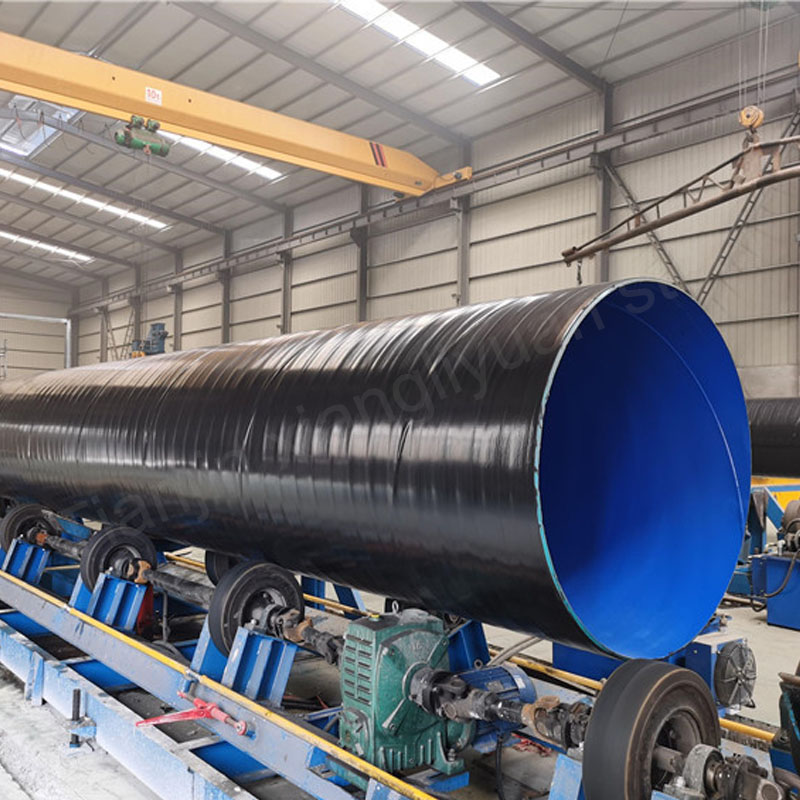
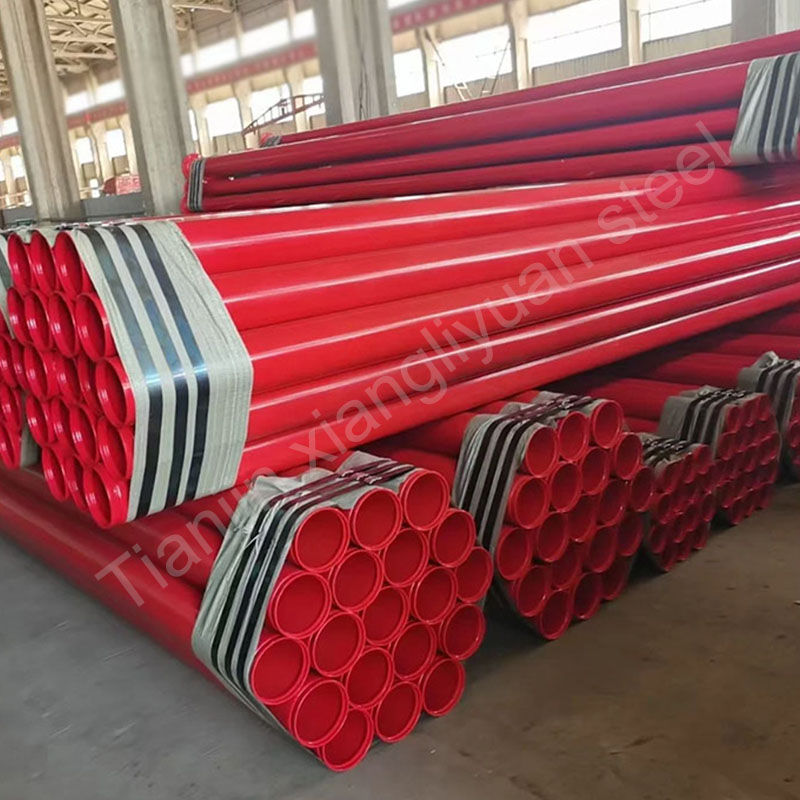
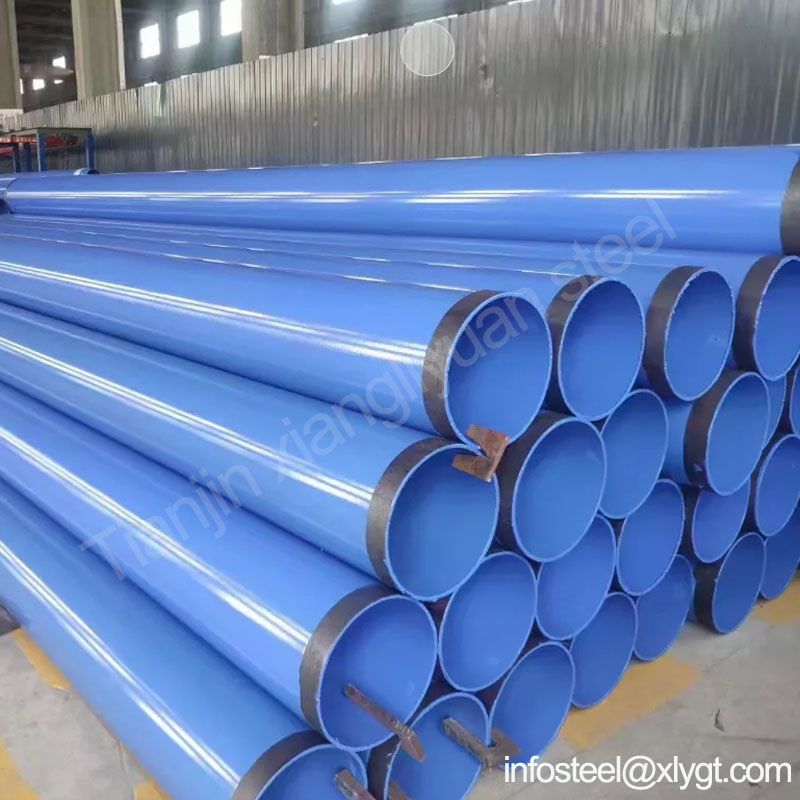
Fusion Bonded Epoxy is a thermosetting epoxy powder coating that is electrostatically applied to pre-heated steel pipe surfaces and then cured to form a tough, continuous protective film . Unlike conventional liquid coatings, FBE undergoes a sophisticated chemical cross-linking reaction during application, creating a high-integrity molecular bond with the prepared steel substrate .
The coating’s chemical composition provides exceptional resistance to water, oxygen, and chloride ion permeation—the three primary vectors of under-coating corrosion . This makes FBE an ideal solution for oil and gas pipelines, water transmission systems, and offshore applications where long-term corrosion protection is essential.
Key Properties of FBE Coated Pipe
-
Corrosion resistance: Superior protection against chemical attack and environmental degradation
-
Cathodic disbondment resistance: High resistance to alkaline environments generated by cathodic protection systems
-
Adhesion strength: Typically exceeding 10 MPa in pull-off tests
-
Operating temperature range: Standard grades: −40°C to +80°C; high-temperature formulations: up to 110–120°C
-
Impact resistance: Moderate resistance requiring careful handling during construction
FBE Coating Application Process
The quality of FBE coating depends fundamentally on the precision of its application and rigorous control throughout each stage . The process follows several critical steps:
1. Surface Preparation
Surface preparation is the most critical factor determining coating performance. The steel pipe surface must be cleaned to remove mill scale, rust, grease, and other contaminants that would compromise adhesion.
Blast cleaning to SA 2½ (near-white metal) per ISO 8501-1 is typically specified for pipeline applications . This standard ensures the surface achieves the required cleanliness level and desired surface profile (roughness) measured in micrometres. Degreasing with solvent cleaning or hot water washing must precede abrasive blasting to prevent embedding residual salts or hydrocarbons into the blast profile, which significantly increases the risk of premature coating failure .
Centrifugal blast cleaning is particularly advantageous for cleaning the exterior of pipes in production-line environments .
2. Pipe Heating
Following surface preparation, the steel pipe is heated to approximately 200–250°C (392–482°F) using induction heating or gas-fired furnaces . This temperature ensures proper melting and flow of the epoxy powder during application and initiates the chemical cross-linking reaction.
3. Powder Application
FBE powder is applied electrostatically using specialized spray guns. The electrostatic charge attracts the powder particles to the heated steel surface, where they melt and flow into a uniform coating layer .
For external coating, the pipe rotates during application to ensure circumferential uniformity. Internal coating applications employ specialized internal spray heads that traverse the pipe length.
4. Curing
The applied coating undergoes a thermosetting reaction, forming a cross-linked polymer network that provides the coating’s final protective properties. Curing temperature and time are critical parameters—insufficient curing results in low chemical resistance and reduced adhesion, while overcuring may generate brittleness and microcracks .
Verification of the curing degree is commonly performed through Differential Scanning Calorimetry (DSC) analysis, ensuring the residual delta Tg is less than 3°C relative to the reference value of the fully cured product .
5. Cooling and Inspection
The coated pipe is cooled under controlled conditions before undergoing comprehensive inspection and testing. At Tianjin Xiangliyuan Steel, we implement rigorous quality control protocols at every stage of the coating process, ensuring compliance with international standards including ISO 21809-1, CSA Z245.20, DIN 30670, and AWWA C213 .
Thickness Standards for FBE Coating
Control of dry film thickness (DFT) is the first critical quality parameter in any FBE coating system. Technical project specifications generally establish DFT requirements based on service conditions and applicable standards.
Standard Thickness Requirements
| Standard | Coating Type | Thickness Requirement |
|---|---|---|
| ISO 21809-2 | Single-layer FBE | 300–500 μm |
| ISO 21809-1 | FBE primer in 3LPE/3LPP | ≥ 300 μm |
| GB/T 39636-2020 | Single-layer FBE | 350 μm ± 50 μm |
| GB/T 39636-2020 | Double-layer FBE | ≥ 600 μm total |
| Typical Spec | Standard transmission pipeline | 350–500 μm |
Thickness Measurement
DFT measurement is performed using calibrated ultrasonic or magnetic induction gauges, taking a minimum of four readings per joint distributed radially to ensure circumferential uniformity of the coating . Equipment calibration using standard test blocks with an error tolerance of ≤±5% ensures measurement accuracy .
At Tianjin Xiangliyuan Steel, our coating facilities accommodate pipe diameters from 168 mm to 1,422 mm (6–56 inches), applying FBE, 2FBE, 2LPE, 3LPE, 3LPP, and CWC systems according to client specifications .
Performance Testing of FBE Coated Pipe
Comprehensive performance testing verifies that the applied coating meets the required service life and operational standards. International standards such as ISO 21809, ASTM, and NACE establish testing protocols for key performance indicators.
Holiday Detection (Porosity Testing)
The detection of discontinuities or pores in the film that expose the base metal is a critical inspection requirement. AMPP SP0188 establishes the protocol for defect detection using high-voltage spark testers .
For films thicker than 500 microns, high-voltage detectors are used with test voltage calculated using the formula of 100V for every 25 microns of nominal thickness, adjusted according to the coating manufacturer’s recommendations to avoid inducing new defects due to overvoltage .
Adhesion Testing
Adhesion is evaluated using pull-off testing per ASTM D4541, requiring a pull-off strength ≥5 MPa with a loading rate of 0.8 MPa/s ±10% . The adhesion of FBE coatings to the base material decreases with increasing temperature, making high-temperature performance critical for pipelines operating at elevated temperatures .
Cathodic Disbondment Testing
ASTM G8 and ASTM G42 establish methods for evaluating resistance to cathodic disbondment—the most relevant degradation mechanism for buried or submerged pipelines operating under cathodic protection .
The test involves applying a cathodic potential of -1.5 V (SCE) for 28 days in a 3% sodium chloride solution, then measuring the radius of disbondment from an artificial defect. Reference values accepted in world-class project specifications set a maximum disbondment radius of:
-
8 mm for standard FBE at ambient temperature
-
6 mm for high-performance formulations at 65°C
-
≤ 15 mm for high-temperature testing per ASTM G42 (80°C)
Impact and Bend Testing
Impact resistance is verified using falling weight tests per ASTM D2794, with specifications typically requiring no cracking under defined impact energy levels . Bend testing per ISO 1519 evaluates coating flexibility by bending specimens around a mandrel of specified diameter .
For buried compressor outlet pipelines and other high-temperature applications, FBE performance requires careful evaluation. Studies demonstrate that exposure to high temperatures and vibrations significantly reduces coating adhesion—approximately 1.3 MPa decrease for each 10°C temperature increase, with combined temperature and vibration exposure reducing adhesion by an additional 50% compared to temperature exposure alone .
International Standards Compliance
Tianjin Xiangliyuan Steel maintains strict compliance with key international coating standards, providing our global clients with documented assurance of quality and performance:
| Standard | Application Scope |
|---|---|
| ISO 21809-1 | External coatings for buried/submerged pipelines |
| AWWA C210 | Liquid epoxy coating systems for water pipelines |
| AWWA C213 | FBE and PE coatings for steel water pipelines |
| CSA Z245.20 | External FBE coating for steel pipe |
| DIN 30670 | Polyethylene coatings for steel pipe |
Our comprehensive quality assurance protocols include holiday detection, peel strength testing, cathodic disbondment evaluation, and chemical composition analysis—ensuring every shipment meets or exceeds project specifications.
Why Tianjin Xiangliyuan Steel?
Strategic Location and Logistics Advantage
Located in Tianjin, China’s premier northern port city, Tianjin Xiangliyuan Steel offers direct access to Xingang Port, China’s largest crude oil import and steel export gateway. This proximity significantly reduces inland transportation costs, enables efficient vessel loading, and supports just-in-time delivery schedules for international EPC contractors .
Manufacturing Excellence
Our coating facilities apply FBE, 2FBE, 2LPE, 3LPE, 3LPP, and CWC systems to pipe diameters from 168 mm to 1,422 mm (6–56 inches), complying with ISO 21809, DIN 30670/30678, AWWA C213/C210, and client-specific engineering specifications .
Global Project Experience
We have successfully executed coating contracts for submarine pipeline projects in Central America, West Africa, and Southeast Asian markets, demonstrating our capability to meet stringent international project requirements .
Fusion Bonded Epoxy coating represents the cornerstone of modern pipeline corrosion protection technology. The reliability of the FBE system depends on rigorous control during application and inspection stages—particularly in critical parameters such as dry film thickness, discontinuity detection, adhesion, and curing verification .
When specifying FBE coated steel pipe for your project, partner with a manufacturer that combines technical expertise, production capability, and logistics efficiency. Tianjin Xiangliyuan Steel delivers all three—along with the documented quality assurance that international projects demand.
For project-specific inquiries, technical datasheets, or competitive quotations, contact our engineering team at infosteel@xlygt.com or explore our complete product range and technical resources at https://www.xlysteel.com/ .