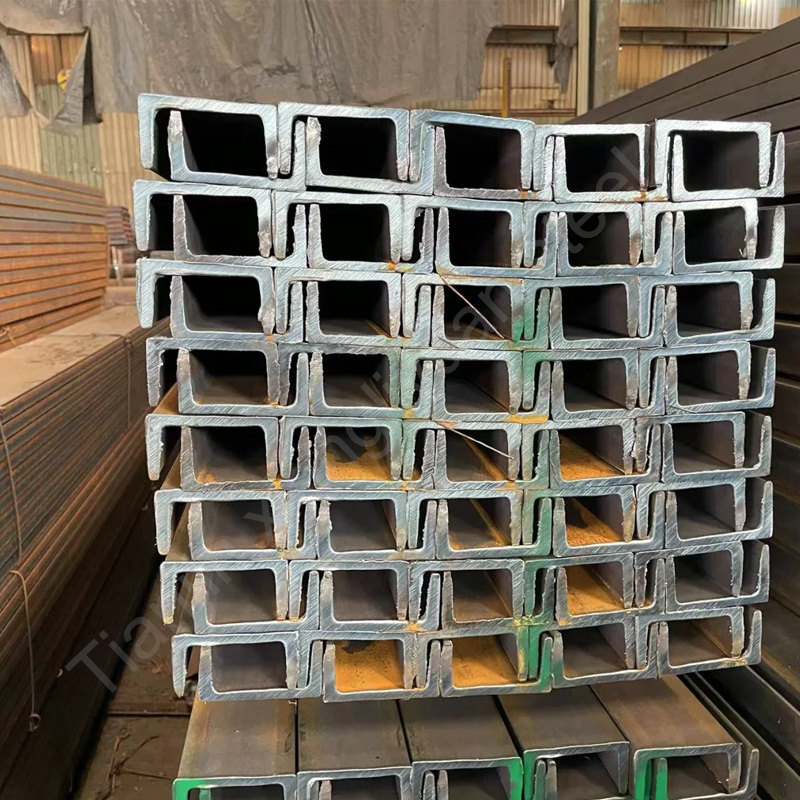
Steel channel sections are fundamental components in modern construction and engineering. Distinguished by their characteristic “U” or “C” shape, these hot-rolled structural steel products offer an exceptional strength-to-weight ratio, making them indispensable for frameworks, supports, and a wide array of load-bearing applications. This comprehensive guide will delve into the technical specifications, dimensional standards, weight calculations, and critical applications of U-Channel and C-Channel steel sections. Our goal is to provide engineers, fabricators, and procurement specialists with the precise technical data required for informed decision-making.
Defining the U-Channel and C-Channel
While often used interchangeably in casual conversation, U-channel and C-channel exhibit distinct geometric profiles that dictate their suitability for different structural roles. The primary difference lies in the flange design .
U-Channel
A U-channel features a cross-section resembling the letter “U”. Its design consists of a flat base (web) with two vertical sides (flanges) that are typically parallel and of uniform height. This shape offers excellent support and stability, making it ideal for applications requiring edge protection, reinforcement, or framing. It is often used to hold flat surfaces securely, such as in glass panel framing, wire mesh supports, and as edging for staircases and escalators .
C-Channel
A C-channel, also known as a C-section, has a shape resembling the letter “C”. While similar to a U-channel, the flanges of a C-channel may have a slight inward curl, providing additional rigidity. More importantly, C-channels are generally produced with longer flanges and are considered stronger and more rigid than U-channels, making them the preferred choice for heavy-duty structural applications such as beams and columns .
Critical Dimensions, Sizes, and Weight Charts
For structural engineers and steel buyers, precise dimensional data is paramount. Steel channels are typically designated by their depth (height of the web), flange width, and weight per unit length (e.g., kg/m or lbs/ft). Standards vary by region, with the most common being ASTM (American), JIS (Japanese), and EN (European) standards.
As a leading steel supplier, Tianjin Xiangliyuan Steel specializes in manufacturing these critical components to meet rigorous international standards. Our proximity to the Port of Tianjin ensures rapid and cost-effective global logistics, minimizing lead times for our international clients.
Standard Dimensions and Weights (ASTM A36 C-Channel)
The table below illustrates the standard properties for ASTM A36 carbon steel C-channels, a staple in the American market. These dimensions are crucial for calculating structural integrity and project costs .
| Designation (in x lb/ft) | Depth (in) | Flange Width (in) | Web Thickness (in) | Sectional Area (in²) | Weight (lb/ft) |
|---|---|---|---|---|---|
| C 15 x 50 | 15.00 | 3.716 | 0.716 | 14.70 | 50.0 |
| C 15 x 40 | 15.00 | 3.520 | 0.520 | 11.80 | 40.0 |
| C 12 x 30 | 12.00 | 3.170 | 0.510 | 8.82 | 30.0 |
| C 12 x 25 | 12.00 | 3.047 | 0.387 | 7.35 | 25.0 |
| C 10 x 30 | 10.00 | 3.033 | 0.673 | 8.82 | 30.0 |
| C 10 x 20 | 10.00 | 2.739 | 0.379 | 5.88 | 20.0 |
| C 8 x 11.5 | 8.00 | 2.260 | 0.220 | 3.38 | 11.5 |
Note: “C 15 x 50” indicates a 15-inch depth channel weighing 50 pounds per foot.
For projects requiring metric specifications, Tianjin Xiangliyuan Steel offers a full range of sizes. For example, standard GB/T channels typically have a height (h) ranging from 50mm to 400mm, with web thicknesses (t) from 4.5mm to 14.5mm .
| Model | Height (mm) | Flange Width (mm) | Web Thickness (mm) | Theoretical Weight (kg/m) |
|---|---|---|---|---|
| 10 | 100 | 48 | 5.3 | 10.00 |
| 14A | 140 | 58 | 6.0 | 14.53 |
| 20B | 200 | 75 | 9.0 | 25.77 |
| 30C | 300 | 89 | 11.5 | 43.81 |
At Tianjin Xiangliyuan Steel, our technical experts can assist in calculating the exact theoretical weight of custom-sized channels based on the formula: Weight (kg/m) = 0.00785 × Cross-Sectional Area (mm²) . This precision ensures accurate budgeting and structural analysis for your projects.
Mechanical Properties and Grade Specifications
The performance of a steel channel is dictated by its material grade. The most common grade is ASTM A36, known for its excellent weldability, formability, and machinability. For applications requiring higher strength, grades like ASTM A572 or A992 are specified .
-
ASTM A36: Yield Strength: 36 ksi (250 MPa). Suitable for general structural applications.
-
ASTM A572 (Gr. 50): Yield Strength: 50 ksi (345 MPa). Higher strength for lighter weight structures.
-
Q235B (GB/T): A common equivalent to A36, widely used in Asia.
We understand that procurement for international construction often requires stringent compliance. Tianjin Xiangliyuan Steel supplies channels certified to ASTM, JIS, DIN, and GB/T standards, ensuring your materials meet local code requirements . Our rigorous quality control ensures material integrity from the melt shop to your job site.
Structural Applications and Industry Use
Steel channels are the backbone of modern infrastructure. Their versatility is unmatched, thanks to their ability to be cut, welded, and drilled using standard fabrication practices .
-
Construction and Infrastructure: The most common application is in building frames, roof trusses, and support beams. They are a primary component in load-bearing structures such as bridges, overpasses, and high-rise buildings . C-channel and U-channel are extensively used as purlins and girts in Pre-Engineered Buildings (PEBs) to support wall and roof sheeting .
-
Automotive and Transportation: In the automotive industry, structural steel channel is utilized in vehicle chassis, truck bed frames, and trailer reinforcements due to its high strength and fatigue resistance .
-
Industrial Machinery: Steel channel is essential in the fabrication of industrial machinery and equipment frames, providing essential support for conveyor systems, production lines, and automated machinery in factories .
-
Marine and Offshore: The marine industry relies on steel channels for constructing ship hulls, decks, and reinforcement components, utilizing heavy-duty C-sections .
-
Renewable Energy: Increasingly, steel channel is used in solar panel mounting systems and wind turbine structures, where durability and wind resistance are critical .
Why Choose Tianjin Xiangliyuan Steel for Your Channel Sections?
When sourcing steel channels for your next project, precision, quality, and reliability are non-negotiable. Tianjin Xiangliyuan Steel (Website: https://www.xlysteel.com/) is a distinguished manufacturer and supplier with a strong foothold in the global steel market. Here is why we are the partner of choice for international buyers:
-
Strategic Location: Based in Tianjin, China, our facility is located minutes from one of the world’s busiest ports. This logistics advantage ensures rapid shipping, lower freight costs, and efficient handling of bulk orders for clients worldwide .
-
Extensive Inventory & Customization: We maintain a large stock of common specifications to ensure the fastest delivery. Furthermore, we offer cutting-to-length and custom fabrication services to meet specific project requirements .
-
Global Standards Compliance: We supply steel channels according to ASTM, JIS, EN, GB/T, and other international standards. Whether you need hot-rolled or cold-formed sections, we provide full material test certificates (MTC) with every shipment.
-
Expert Support: Our team of metallurgical and structural experts provides free consultation to help you select the right grade and size for your application. We don’t just sell steel; we provide engineering solutions.
Contact Us
Ready to discuss your next project? Our team is on standby to provide competitive quotes and technical support. We welcome you to explore our extensive product range or reach out directly.
Tianjin Xiangliyuan Steel
-
Email: infosteel@xlygt.com
-
Website: https://www.xlysteel.com/
Partner with Tianjin Xiangliyuan Steel for quality, reliability, and value.