In the world of structural steel, few debates are as enduring—or as misunderstood—as the comparison between H-beam and I-beam sections. For engineers, procurement specialists, and construction professionals, this is not merely an academic exercise. The choice directly impacts project cost, structural integrity, fabrication complexity, and long-term durability. At Tianjin Xiangliyuan Steel, we have supplied high-quality steel sections for projects ranging from high-rise building frames to heavy industrial infrastructure. Our strategic location in Tianjin, adjacent to one of the world’s busiest ports, ensures fast delivery and competitive logistics for clients worldwide.
This guide provides a rigorous, engineering-driven comparison between H-beam and I-beam steel sections. We will examine their geometric distinctions, mechanical behavior under various load conditions, weight efficiency, and practical application scenarios. By the end, you will understand why the selection process must move beyond visual identification to a thorough analysis of section properties and design code requirements, such as ASTM A1043/A1043M or Eurocode 3 .
Defining the Sections: Beyond Visual Identification
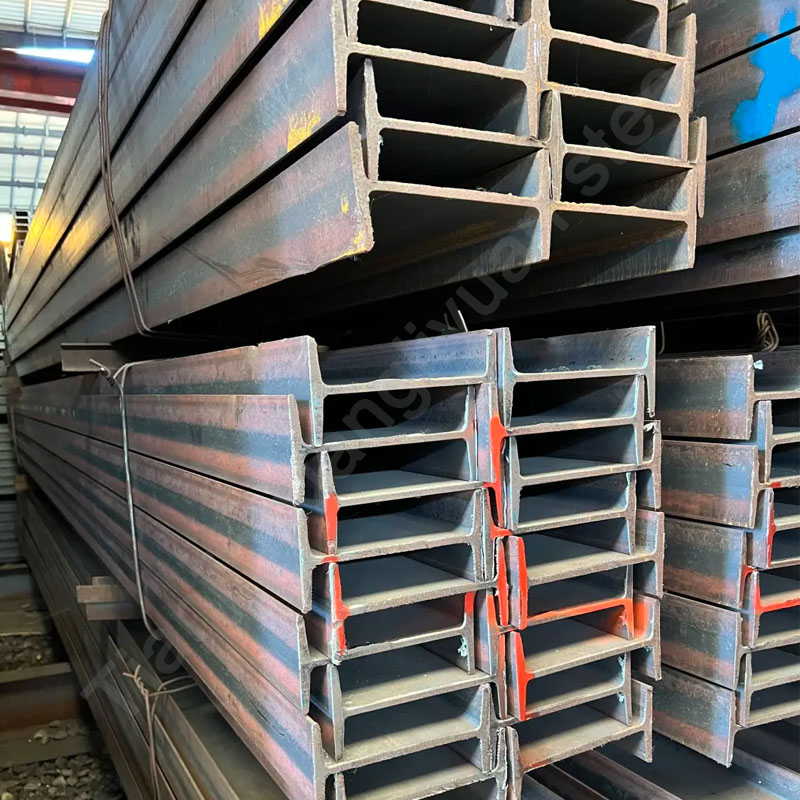
The terms “H-beam” and “I-beam” are descriptive nicknames rather than strict engineering classifications. In practice, structural design is driven by standardized profiles with precise geometric and mechanical properties. For example, in the American market, wide-flange sections (W-shapes) are commonly referred to as H-beams, while S-shapes are designated as I-beams. In Europe, classifications like IPE, IPN, HEA, HEB, and HEM are used, each with specific dimensional characteristics .
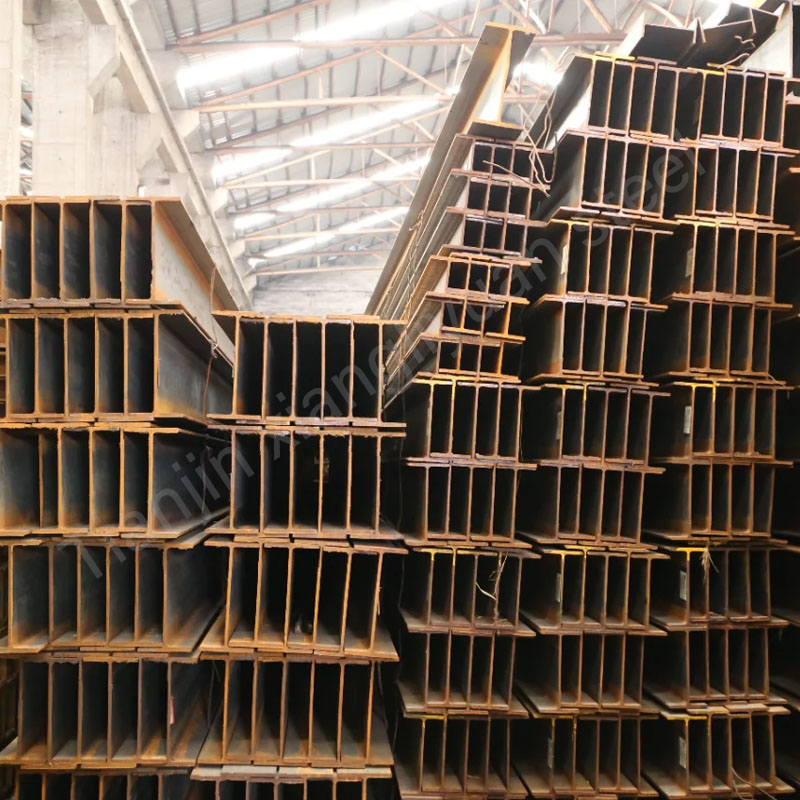
The fundamental distinction lies in their geometry. An I-beam typically features a taller, narrower profile with flanges that may have a slight internal taper (often 1:6 in older standards). This design optimizes material distribution for bending about its strong axis . An H-beam, conversely, has wider, more parallel flanges and a thicker web relative to its depth. This creates a more balanced cross-section, providing significantly greater strength and stiffness about its weak axis . This visual difference is the first clue to their distinct structural roles.
Structural Performance: Bending, Buckling, and Axial Load
Strong-Axis Bending Efficiency
The primary performance indicator for beams is their resistance to bending. The section modulus (S or Z) and the second moment of area (I) about the major axis dictate this capacity. A deeper section generally provides greater strong-axis bending efficiency because more material is placed further from the neutral axis . An I-beam, with its taller profile for a given weight, excels in this regard. H-beams, while also efficient, are often heavier for a comparable depth.
However, pure strong-axis bending capacity is only one part of the design equation. Structural systems rarely exist in such isolation.
Lateral-Torsional Buckling
For beams, especially those with long unsupported spans, lateral-torsional buckling (LTB) is often the governing limit state. LTB occurs when a beam deflects laterally and twists under load . The resistance to LTB depends on factors such as the unbraced length, torsional stiffness, and the geometry of the compression flange. H-beams, with their wider flanges and higher torsional constant (J), generally offer superior resistance to LTB compared to equivalent I-beams, making them a more stable choice for long-span applications where lateral bracing is limited.
Axial Compression and Column Behavior
When steel sections are used as columns, the critical performance metrics shift from bending capacity to resistance against global buckling and local flange/web instability . The radius of gyration (r) is a key parameter here, as it defines the slenderness ratio (KL/r), a principal factor in determining column strength .
-
H-Beams: The wider flanges provide a significantly larger radius of gyration about the weak (y-y) axis. This means an H-beam column will have greater resistance to buckling in its weaker direction compared to an I-beam of similar depth and weight. This balanced strength profile makes H-beams ideal for columns and other compression members.
-
I-Beams: While I-beams can be used as columns, their weak-axis stiffness is inherently lower. They are more susceptible to buckling about the weak axis unless properly braced. This is why, for heavy column applications, H-beams are the preferred and more economical choice.
Shear and Web Resistance
Shear forces are primarily resisted by the web of the section. A thicker web, as often found in H-beams, provides greater resistance to shear yielding, web crippling, and web buckling . This is particularly critical near supports, under concentrated loads, and in heavily loaded short-span beams.
Weight Efficiency and Material Economy
Weight efficiency is a crucial economic factor in structural design. It directly impacts material cost, foundation requirements, transportation, and erection labor. I-beams are generally more weight-efficient for pure bending applications. Their design concentrates material at the flanges, maximizing the section modulus for a given weight.
H-beams, while heavier for a comparable depth, provide greater strength and stiffness in multiple directions. The trade-off is often justified by the reduction in secondary structural elements (like bracing) and the ability to handle more complex load cases . Moreover, H-beams are considered an “economical and high-efficiency profile” because their optimized cross-sectional area distribution results in a more reasonable strength-to-weight ratio for columns and heavily loaded members . For projects where steel tonnage and self-weight are critical, a detailed comparison of section properties will reveal the most economical solution.
Application Selection Guide
Choosing between an H-beam and an I-beam is a matter of matching the section’s strength profile to the demands of the application.
When to Select an I-Beam:
-
Floor and Roof Systems: Where members primarily act in simple, unidirectional bending.
-
Light-to-Moderate Frames: In buildings where spans are not excessive and loads are predictable.
-
Weight-Sensitive Applications: When minimizing dead load is a priority.
-
Cost-Effective Framing: For conventional beams, rafters, and secondary framing elements where standard rolled sections are economical .
When to Select an H-Beam:
-
Columns and Heavy Vertical Members: Where axial load and bi-axial bending are the primary design drivers .
-
Long-Span Beams: Where lateral-torsional stability is a concern.
-
Bridge and Industrial Structures: Where the structure must withstand heavy, dynamic, and multi-directional loads.
-
Pile Foundations: HP-shapes are specifically designed for this application .
-
Members Requiring High Weak-Axis Stiffness: Such as frames in seismic zones or equipment support structures .
-
Connections: The parallel flanges of H-beams simplify connection detailing with high-strength bolts .
Why Choose Tianjin Xiangliyuan Steel?
At Tianjin Xiangliyuan Steel, we understand that the success of your project depends on receiving the right material, with the right certification, at the right time. Our commitment to quality is unwavering. We carry a vast inventory of structural steel, from API 5L line pipe and ASTM A252 pipe piling to a comprehensive range of H-beam and I-beam sections to meet ASTM, EN, JIS, and GB standards. To learn more about our full product range, please visit our official website: https://www.xlysteel.com.
Located in Tianjin, we benefit from our proximity to the Tianjin Port, one of the world’s largest and most efficient maritime hubs. This logistical advantage allows us to offer fast delivery and competitive shipping costs to clients across North America, South America, Europe, Africa, Oceania, the Middle East, and Southeast Asia . Our strategic location and stock warehouse mean we can ship within 3 to 5 days for urgent orders, minimizing project downtime.
We pride ourselves on a 24/7 professional service team ready to assist with technical specifications and order fulfillment. We source directly from mills, ensuring low prices without compromising on quality. Every shipment undergoes rigorous physical and chemical testing to guarantee that what you receive is the highest quality material, never short weight. We guarantee all steel meets stringent standards, with independent chemical composition and mechanical properties analysis available upon request .
The choice between an H-beam and an I-beam is a fundamental structural decision that must be based on a comprehensive analysis of the design requirements. I-beams excel in efficient strong-axis bending, while H-beams offer superior weak-axis stiffness, column strength, and resistance to lateral-torsional buckling. The selection should be guided by section properties, steel grade (such as ASTM A572 Grade 50), and the governing code, not just the visual “I” or “H” designation .
Tianjin Xiangliyuan Steel is your trusted partner in navigating these critical choices. Our deep industry expertise, combined with a client-centric approach, ensures you receive the best possible solution for your structural steel needs. We are dedicated to providing high-quality, affordable steel sections with the fastest possible delivery from our Tianjin port location.
Contact us today to discuss your project requirements.
Tianjin Xiangliyuan Steel
Email: infosteel@xlygt.com
Website: https://www.xlysteel.com
Address: Tianjin, China (Near Tianjin Port)
We are ready to provide you with a professional, responsible, and long-term partnership.