In the specification of steel-plastic composite water supply pipes for municipal, industrial, and building services, two parameters frequently dominate the technical discussion between suppliers and EPC contractors: the internal coating thickness and the pressure-bearing performance. These are not arbitrary figures. They are interlocked variables that determine whether the pipeline will deliver a 50-year service life or become a maintenance liability within a decade.
At Tianjin xiangliyuan steel, we have observed that international buyers increasingly scrutinize these two metrics independently during pre-qualification. A supplier that cannot explain the relationship between coating thickness and pressure resistance—or the standards governing both—is not a reliable partner for infrastructure projects. This technical bulletin addresses that gap directly.
Why the 0.3–0.5mm Internal Coating Range Matters
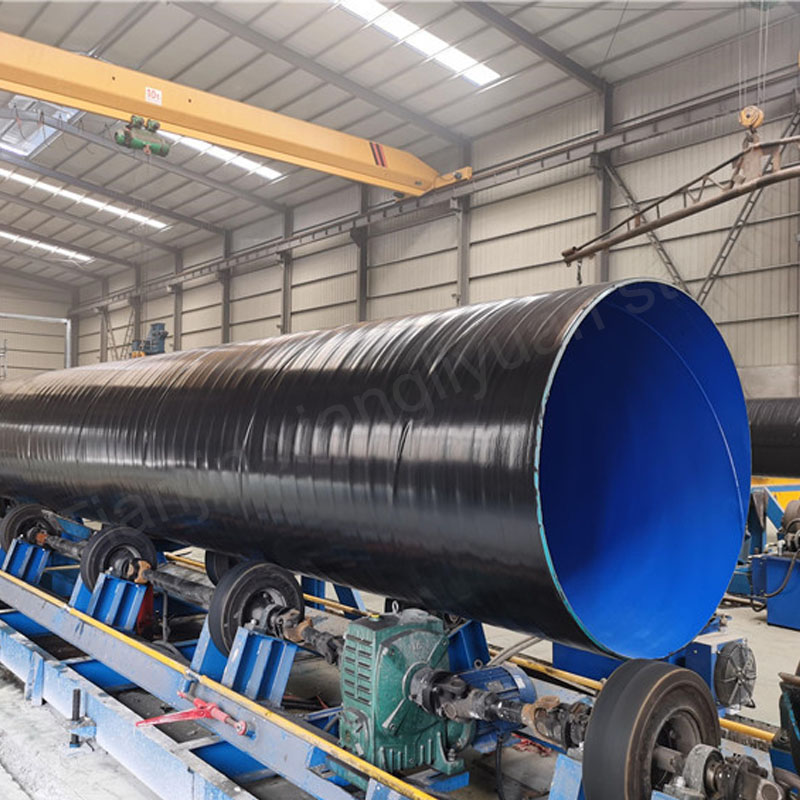
The internal coating of a steel-plastic composite water supply pipe serves a dual function: it isolates the carbon steel substrate from the conveyed water, and it provides a hydraulically smooth surface that resists scaling and reduces friction loss. For epoxy resin (EP) and polyethylene (PE) linings, the specified dry film thickness (DFT) is a critical control point.
Industry standards provide the baseline. According to GB/T 28897-2021, the minimum coating thickness for epoxy resin internal linings is generally specified at ≥100μm (0.1mm), while polyethylene coatings typically require ≥400μm (0.4mm) . However, for potable water and higher-pressure applications, the engineering consensus often moves toward the 0.3–0.5mm band. This range represents the practical optimum: sufficient film build to guarantee continuity and corrosion barrier integrity, without introducing excessive internal stress that could lead to coating disbondment under thermal cycling.
The lower bound of 0.3mm is not merely a thickness number. It is the threshold below which the probability of discrete pinholes—holidays—increases disproportionately. A single holiday in a water supply coating creates a galvanic corrosion cell. The steel beneath the coating becomes anodic relative to the surrounding coated surface, and localized pitting can penetrate a pipe wall far faster than uniform corrosion would suggest. For this reason, reputable manufacturers perform 100% holiday detection on internal linings, using low-voltage wet sponge testing for thin films up to 500μm (0.5mm) in accordance with standards such as NACE SP0188 and ASTM D5162 .
At the upper bound of 0.5mm, the concern shifts from corrosion protection to mechanical integrity. Excessive epoxy thickness can reduce flexibility and increase the risk of cracking during pipe handling, jointing, or thermal expansion. It also adds unnecessary material cost without a proportional gain in barrier performance. The 0.3–0.5mm window is therefore a deliberate engineering compromise—thick enough to protect, thin enough to perform.
At Tianjin xiangliyuan steel, our internal coating application lines are configured to hold this range consistently across pipe diameters from DN15 upward, with in-house DFT verification performed on both ends of every coated length before shipment. Our location in Tianjin, minutes from one of North China’s busiest ports, allows us to consolidate and ship coated pipe orders efficiently to international project sites without extended inland transit delays.
Pressure-Bearing Performance: The Steel Substrate Does the Work
A common misconception among procurement teams new to composite pipes is that the plastic coating contributes to pressure containment. It does not. The pressure-bearing capacity of a steel-plastic composite water supply pipe is governed almost entirely by the steel substrate—its wall thickness, yield strength, and weld quality. The plastic lining is a corrosion barrier and a flow enhancement layer, not a structural element.
This distinction has practical consequences for specification. When a project requires a working pressure of 1.6MPa, the steel wall thickness must be selected accordingly, regardless of whether the internal coating is 0.3mm or 0.5mm. The coating thickness influences corrosion allowance and service life, but it does not add hoop strength.
The relevant benchmarks for pressure performance are well established. CJ/T 120-2016, the Chinese industry standard for plastic-coated steel pipes for water supply, specifies a minimum hydrostatic test requirement of ≥1.6MPa for fire protection and municipal water applications . For higher-demand services, coated steel pipes with adequate steel wall thickness can achieve working pressures of 4.5MPa and beyond, with reported maximum pressure capacities reaching 6MPa in certain configurations . The limiting factor in these higher-pressure applications is the steel, not the coating.
What the coating must do under pressure is remain adhered. Pressure fluctuations—water hammer events, pump cycling, and surge conditions—impose cyclic mechanical stress on the coating-steel interface. If adhesion is inadequate, the coating can delaminate at the edges or blister where permeation has occurred. This is why adhesion testing, typically targeting ≥30N/10mm pull-off strength, is as important as thickness measurement in a quality control program . A pipe that passes a hydrostatic test at the factory but fails adhesion criteria may still develop lining separation after months of service.
For buyers specifying steel-plastic composite water supply pipe, the correct approach is to treat coating thickness and steel wall thickness as separate but complementary requirements. The coating specification (0.3–0.5mm) addresses corrosion life; the steel specification addresses pressure containment. A supplier who understands both—and can document compliance with both—is the one worth engaging.
How Tianjin xiangliyuan steel Controls Both Variables
Our production philosophy at Tianjin xiangliyuan steel is built around the principle that coating quality and pressure integrity are verified, not assumed. For steel-plastic composite water supply pipes, this means:
Incoming steel verification. Base pipes are checked for wall thickness, yield strength, and weld integrity before entering the coating line. A coating applied to a substandard steel substrate is a liability, not a product.
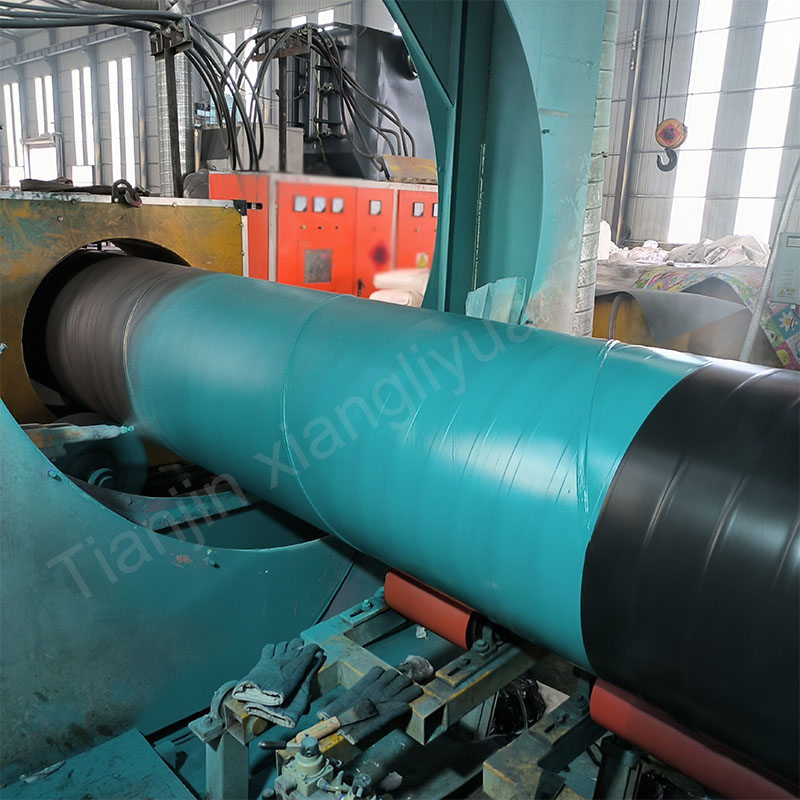
Coating process control. Internal coating thickness is monitored during application and verified post-cure using calibrated electromagnetic gauges at multiple circumferential points per pipe end, following established procedures for dry film thickness measurement . The target window is maintained within the 0.3–0.5mm range unless a project specification calls for a different standard.
Holiday detection. Every internally coated water supply pipe undergoes low-voltage wet sponge testing to identify discontinuities that visual inspection would miss. This is a non-negotiable step for potable water and fire protection service.
Hydrostatic testing. Pressure integrity is confirmed at the specified test pressure, typically 1.5 times the working pressure, in accordance with applicable project or standard requirements.
Documentation. Mill test certificates, coating thickness records, and test reports are compiled for each shipment. For international buyers, this documentation package supports customs clearance and third-party inspection.
Our facility’s proximity to Tianjin Port is a practical advantage for export orders. Coated steel pipes are bulky and heavy; inland transport costs and handling damage risk increase with distance. Shipping from Tianjin allows us to load containers or break-bulk vessels with minimal pre-shipment handling, reducing the likelihood of coating damage in transit and shortening the overall lead time from order confirmation to vessel departure.
Selecting the Right Specification: A Note for International Buyers
For procurement engineers finalizing a steel-plastic composite water supply pipe specification, the following framework may be useful:
-
Determine the governing standard. If the project is in a jurisdiction that recognizes Chinese standards, GB/T 28897-2021 and CJ/T 120-2016 provide a defensible baseline for coating thickness and pressure testing . For projects specifying ASTM or EN frameworks, confirm with the manufacturer that testing protocols align.
-
Separate coating and pressure requirements. Specify internal coating thickness (e.g., 0.3–0.5mm epoxy) and steel wall thickness independently. Do not accept a “pressure rating” that does not state the steel wall thickness on which it is based.
-
Require holiday detection records. A coating thickness measurement alone does not prove coating continuity. Ask for holiday test results as part of the inspection documentation.
-
Confirm adhesion testing. Pull-off adhesion strength is the best available indicator of long-term lining stability. A minimum of 30N/10mm is a reasonable threshold for epoxy linings .
-
Consider the logistics. For buyers in Southeast Asia, the Middle East, Africa, and the Americas, the shipping port matters. A supplier near a major port reduces transit time and handling risk.
Tianjin xiangliyuan steel supplies steel-plastic composite water supply pipes, plastic-coated steel pipes, and related anti-corrosion steel pipe products to international contractors and distributors. For technical inquiries, specifications, or quotation requests, contact us at infosteel@xlygt.com or visit https://www.xlysteel.com/. Our technical team responds to international inquiries within one business day.
This bulletin is provided for informational purposes and reflects the manufacturer’s understanding of applicable standards and good practice as of the date of publication. Project-specific requirements should be confirmed with a qualified engineer.