The Critical Role of Thread Precision in the Global Energy Supply Chain
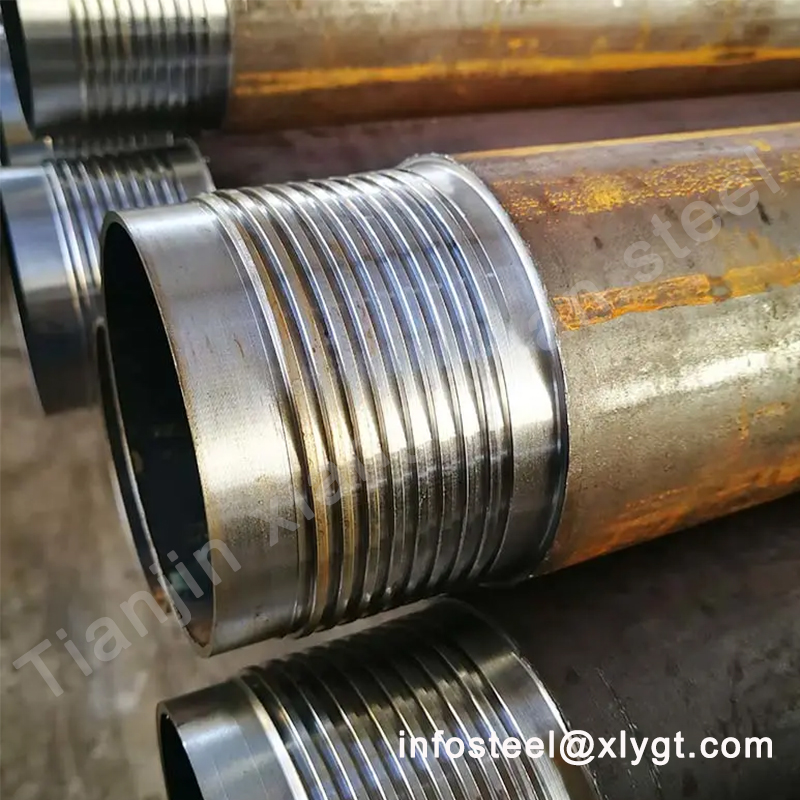
In the world of Oil Country Tubular Goods (OCTG), Line Pipe, and Casing and Tubing, the connection is the weakest link. A single failed thread due to improper thread taper, lead, or height can lead to catastrophic string failure, millions of dollars in non-productive time (NPT), and environmental hazards.
For international buyers—from the rig operators in Texas to pipeline constructors in Dubai—the difference between a reliable supplier and a liability is precision control. This article dissects the technical anatomy of API 5B gauge inspection and thread parameter measurement, establishing why third-party verified machining is non-negotiable.
At Tianjin xiangliyuan steel, we don’t just cut threads; we certify them. Located in the industrial heart of Tianjin, China, with immediate proximity to the Port of Tianjin (one of the world’s busiest shipping hubs), our finished products move from our QC lab to your project site with unmatched efficiency. For inquiries, reach us at infosteel@xlygt.com or visit https://www.xlysteel.com.
Understanding the API 5B Standard – The Bible of Pipe Threading
The American Petroleum Institute (API) Standard 5B, “Threading, Gauging, and Thread Inspection of Casing, Tubing, and Line Pipe Threads,” is the definitive global benchmark. It specifies the dimensions, tolerances, and gauging practices for threads used in seamless steel pipes, ERW pipes, and coupling stock.
Why API 5B matters for your drilling program
Without strict adherence to API 5B, a round thread casing (RTC) or buttress thread casing (BTC) will fail to achieve the required joint strength. Common field failures include:
-
Jump-out: Low load flanks due to improper thread height.
-
Gallings due to insufficient thread lubricant control or rough flanks.
-
Leaks due to improper thread taper causing a lack of interference fit.
Tianjin xiangliyuan steel maintains a full set of master gauges (working and reference) certified to the API 5B standard. We understand that for a pipe supplier, traceability is not just paperwork; it is integrity. Verify our capabilities at https://www.xlysteel.com.
The Core Parameters – Moving Beyond “Good Enough”
Precision control is data-driven. When inspecting steel pipe threads, four primary parameters define functional interchangeability.
2.1 Thread Taper (1:16 Ratio)
The taper of API threads is 1 inch in 16 inches (0.75 inches per foot on diameter). Deviation here results in either a “high torque” condition (tight at the top) or a “loose standing” condition (seal failure).
-
Inspection Tool: API 6-step taper gauge.
-
Tolerance: ±0.0002 inches per inch for master gauges.
2.2 Thread Lead (Pitch)
Lead is the distance a thread advances axially in one revolution. For 8-round threads, this is 8 threads per inch.
-
The Risk: Accumulated lead error over a 20-inch coupling length will misalign the box and pin, causing cross-threading.
-
Measurement: Using a thread lead comparator or specialized lead scanner.
2.3 Thread Height (Crest to Root)
The API thread height for 8-round casing is 0.0710 inches (cut thread) or 0.0625″ (milled). A truncated crest reduces shear area.
-
Inspection Tool: Thread depth micrometer or optical comparator.
2.4 Thread Angle & Flank
The 60-degree symmetric thread angle must be maintained. Flank angle errors cause point loading, premature fatigue, and stripping.
At Tianjin xiangliyuan steel, every batch undergoes statistical process control (SPC) logging. We provide Material Test Reports (MTRs) and full dimensional reports with every shipment. Send your RFQ to infosteel@xlygt.com.
The Hardware – API 5B Gauges and Calibration
You cannot measure with a broken ruler. The hierarchy of thread gauges is the foundation of accuracy.
| Gauge Type | Function | Critical for |
|---|---|---|
| Master Gauge | Reference standard (Never used in field) | Calibrating working gauges |
| Working Gauge | Daily production inspection | Internal QC |
| Transfer Gauge | Verifying working gauge wear | Audit compliance |
| Ring & Plug Gauges | “Go/No-Go” for pitch diameter | Nipple and coupling verification |
The “Stand-Off” measurement
For API Line Pipe threads (NPT/NPTL), the gauge stand-off (distance from the gauge face to the pipe end) is critical. API 5B defines strict limits (e.g., +1 to -1.5 turns for 8-round). A pipe that screws too far (“deep”) or not enough (“proud”) fails immediately.
Tianjin xiangliyuan steel operates a climate-controlled metrology lab (68°F / 20°C) to ensure thermal expansion does not skew results. Because we are located in Tianjin, our logistics chain ensures that certified products reach major ports (Houston, Rotterdam, Singapore) faster than inland competitors. Explore our inventory at https://www.xlysteel.com.
Advanced Measurement Techniques (Beyond Hand Gauges)
While the “stab and turn” method is standard for field inspection, modern thread processing requires digital verification.
4.1 Laser Profilometry
Non-contact laser scanners map the entire thread profile in 3D. This detects helical run-out and periodic errors that ring gauges miss.
-
Benefit: 100% inspection without wear on the gauge.
4.2 Coordinate Measuring Machine (CMM)
For high-volume OCTG processing, a CMM with a rotary table measures taper, lead, and flank angle simultaneously. Accuracy to ±1 micron ensures zero rejects on the rig floor.
4.3 Recess & Thread Relief Inspection
Often overlooked, the thread relief (the unthreaded area behind the thread) must have a smooth radius. Stress risers here propagate cracks.
-
Standard: API 5B requires no tool marks deeper than 0.002 inches.
Tianjin xiangliyuan steel invests in digital inspection hardware to eliminate human error. We know that for seamless pipe destined for sour service (H2S), even a micro-crack at the thread root is a fracture waiting to happen. Contact our engineers for consultation: infosteel@xlygt.com.
Common Thread Processing Defects (And How We Eliminate Them)
To demonstrate expertise, one must acknowledge failure modes. Here is how professional pipe machining avoids these pitfalls:
Defect 1: Chasers Chatter
Cause: Loose tooling or incorrect RPM.
Result: Waves across the flanks (leak path).
Tianjin xiangliyuan steel solution: Solid carbide chasers and CNC-controlled speeds with rigid tapping heads.
Defect 2: Pitch Diameter Taper
Cause: Dull cutting insert or swarf build-up.
Result: A “barrel” shape (tight at ends, loose in middle).
Solution: Active cooling and 100% pitch diameter mapping via air gauging.
Defect 3: Burrs at the Entry Chamfer
Cause: Insufficient deburring cycle.
Result: Damage to coupling seals during stabbing.
Solution: Automated robotic deburring stations with magnification validation.
By mitigating these defects, Tianjin xiangliyuan steel guarantees that your octg pipes thread perfectly on the first attempt, saving your team thousands in rig time.
The Logistics Advantage – Why Tianjin?
Technical capability is useless if the product is stuck in a logistics queue. As Tianjin xiangliyuan steel, we are strategically located less than 50 kilometers from the Tianjin Port, the largest port in Northern China and the gateway for steel exports.
The “Port Proximity” benefit for your supply chain:
-
Lower inland freight: We pass trucking savings to your landed cost.
-
Faster loading: LCL (Less than Container Load) or FCL ready within 24 hours of QC release.
-
Rigorous anti-rust protection: We apply VCI paper and plastic end-caps inside 40ft containers to prevent salt-air corrosion while awaiting vessel departure.
When you search for “steel pipe suppliers” or “casing pipe manufacturers” with reliable export logistics, remember that a thread inspection is only as good as the delivery schedule. Check our lead times at https://www.xlysteel.com.
The Inspection Checklist – What should be in your QC Report?
For the discerning procurement officer or third-party inspector (SGS, BV, Intertek), the following data points signify a premium thread protector and pipe supplier. Ensure your vendor provides:
-
API Monogram License Number (verifiable on API’s website).
-
Working Gauge Calibration Certificate (Traceable to NIST or equivalent).
-
Stand-off Measurement Data (Minimum & Maximum for the lot).
-
Taper Measurement Graph (Visual slope data).
-
High-Res Photos of Starting Threads & Run-out.
-
Certification of Thread Compound applied (If thread-basted).
Tianjin xiangliyuan steel includes this data package digitally with every shipment. We understand that your internal QA team needs traceability for ISO 9001 and API Q1 audits. Request our standard packing list format at infosteel@xlygt.com.
Introduction to Tianjin xiangliyuan steel – Your Threading Partner
We are not just traders; we are processors. Tianjin xiangliyuan steel operates dedicated CNC threading lines for API 5CT casing, API 5L line pipe, and connecting nipples.
Why global buyers choose us:
-
Inventory: Solid stock of L245, X42, X52, X65, and J55/K55 materials.
-
Range: OD from 21.3mm (1/2″) up to 508mm (20″) for threading.
-
Thread Types: LTC (Long Thread Casing), STC (Short Thread Casing), BTC (Buttress), NPT, and BSPT.
-
Value-add: We also supply steel pipe couplings, thread protectors, and beveled ends.
Our commitment to precision control is our brand. We seal every threaded connection with a quality stamp that includes our lot number and pipe heat number. By integrating our machining with our strategic location, we provide a “Mill-to-Rig” reliability that inland suppliers cannot match.
SEO & Customer FAQs (Addressing Buyer Intent)
To assist your search for “threaded pipe for sale” or “premium connection casing”, here are direct answers to common queries.
Q: Can you provide thread protrusion measurements?
A: Yes. For coupling and pipe combinations, we calculate TPI (threads per inch) and protrusion to API 5B Table 8. Contact infosteel@xlygt.com for a sample report.
Q: Do you handle “repair threading”?
A: Yes. We can re-cut damaged threads on used drill pipe or casing, provided the pipe body meets the remaining wall thickness requirement.
Q: Is your gauge set calibrated annually?
A: Absolutely. We maintain a 12-month calibration cycle with an accredited third-party lab. Certificates are available upon request.
Q: What is your shipping distance to the US Gulf?
A: From Tianjin Port to Houston or New Orleans is approximately 30-35 days, depending on the shipping line. We coordinate with freight forwarders to offer CIF (Cost, Insurance, Freight) and FOB Tianjin terms.
Don’t Gamble on Your Connections
In the high-stakes environment of oil, gas, and water transmission, a pipe thread is an engineered failure point. Without rigorous API 5B gauge inspection and thread parameter measurement, you invite leaks, slips, and loss of well integrity.
Tianjin xiangliyuan steel invites you to experience the difference of a manufacturer that treats every thread like a contract. From our initial RFQ response to the final loading crane at Tianjin Port, we prioritize accuracy, documentation, and speed.
Ready to upgrade your supply chain?
Visit our technical library at https://www.xlysteel.com
Send your specifications to infosteel@xlygt.com
Call or WhatsApp our export team (Contact details on website).
Let us not just sell you pipe; let us engineer your connection success.