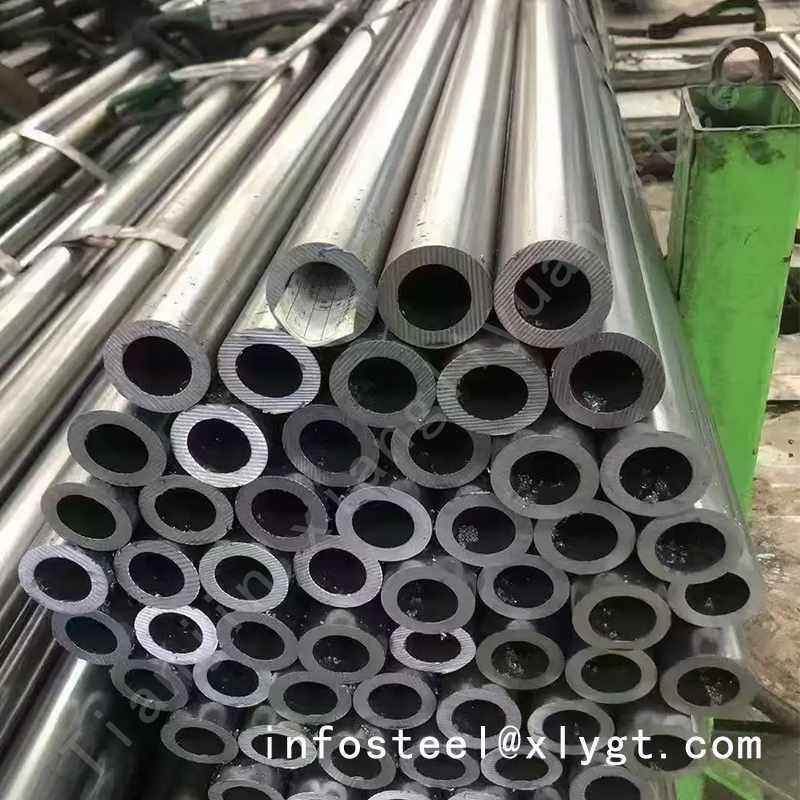
A Technical Analysis for Procurement Engineers and Manufacturing Decision-Makers
Executive Summary
In CNC machining operations, the choice of raw material stock directly determines machining time, tool wear, scrap rate, and ultimately the cost-per-part. For manufacturers producing hydraulic cylinders, automotive shafts, bearing housings, and precision mechanical components, the transition from solid bar stock to tight-tolerance precision steel tubes can reduce total material waste by 30-35% while simultaneously cutting cycle times and improving dimensional consistency.
This analysis examines the technical mechanisms behind these savings, drawing on established manufacturing engineering principles and industry data. For manufacturers seeking a reliable supply partner, Tianjin Xiangliyuan Steel combines cold-drawn precision tube expertise with a strategic logistics position adjacent to Tianjin Port, enabling efficient global delivery of these performance-critical materials.
1. The Material Efficiency Problem in CNC Machining
1.1 The Cost of Solid Bar Stock
Traditional CNC machining of tubular components—hydraulic cylinder barrels, drive shafts, bearing races, and bushings—typically begins with solid round bar stock. The fundamental inefficiency is unavoidable: to create a hollow component from a solid workpiece, material must be removed from the core.
Industry studies indicate that when machining a solid round into a mechanical tube or hollow component, approximately 45% of the solid round material must be removed as chips . For high-value alloys, this represents not only material cost but also:
-
Extended machining cycle times
-
Increased tool wear from volume material removal
-
Higher energy consumption per part
-
Additional chip handling and recycling costs
-
Greater thermal distortion risk from prolonged cutting
1.2 Where Waste Accumulates
Material waste in CNC operations occurs across multiple stages:
| Waste Source | Typical Impact |
|---|---|
| Core removal from solid bar | 40-50% of raw material |
| Oversized stock requiring multiple passes | 15-20% additional cycle time |
| Inconsistent dimensions causing scrap | 3-8% rejection rate |
| End cuts and remnant disposal | 2-5% of bar length |
The cumulative effect is substantial. A manufacturer producing 10,000 hydraulic cylinder barrels annually from solid bar stock may purchase 30-40% more steel than the finished parts actually contain.
2. The Precision Tube Solution: Near-Net Shape Advantage
2.1 What “Tight-Tolerance” Means in Practice
Precision steel tubes—specifically cold-drawn seamless (CDS) and DOM (Drawn Over Mandrel) tubes—are manufactured to dimensional tolerances significantly tighter than standard pipe products. Typical specifications include:
-
Outer diameter tolerance: ±0.05 mm to ±0.10 mm (versus ±0.5 mm or greater for standard pipe)
-
Inner diameter tolerance: ±0.05 mm to ±0.08 mm for plug-drawn products
-
Wall thickness variation: ±8% of nominal wall
-
Concentricity: Controlled to minimize eccentricity
These tolerances are not arbitrary—they are engineered to match the requirements of CNC machining operations. When a tube arrives within 0.10 mm of finished dimension, the machining allowance required to achieve final specification is minimized.
2.2 The Near-Net Shape Principle
The concept of “near-net shape” describes material supplied in a form that closely approximates the finished component geometry, minimizing subsequent material removal . For tubular components, precision steel tubes function as near-net shape input because:
-
The hollow core already exists — eliminating the most wasteful machining operation
-
Wall thickness is controlled — reducing the need for boring operations
-
Concentricity is maintained — ensuring uniform machining allowance around the circumference
-
Surface finish is superior — often eliminating or reducing finishing operations
Manufacturers using precision tubes as CNC input report that material utilization rates can exceed 90% in favorable applications, compared to 55-65% for solid bar processing .
3. Quantifying the 35% Waste Reduction
3.1 Material Savings Mechanisms
The 35% waste reduction figure represents the cumulative effect of several efficiency gains:
Core Material Elimination (20-25% savings)
By starting with a hollow tube rather than solid bar, the material that would have been drilled or bored out is never purchased. For a component with a bore diameter representing 40% of the outer diameter, this alone eliminates approximately 40% of the cross-sectional material .
Reduced Machining Allowance (5-8% savings)
Tight-tolerance tubes require less stock removal to reach final dimensions. Where solid bar might require 2-3 mm of radial stock removal, a precision tube may require only 0.5-1.0 mm . This directly translates to lower chip volume and less material purchased as “machining allowance.”
Scrap Rate Reduction (3-5% savings)
Consistent tube dimensions mean more predictable machining processes. Statistical process control (SPC) data from precision tube users shows reduced dimensional variation in finished parts, leading to fewer rejections and less rework .
End Cut Optimization (2-3% savings)
Cut-to-length precision tubes reduce remnant waste compared to standard bar stock that must be cut and faced before machining.
3.2 The Compound Effect on Total Cost
Material savings alone do not capture the full economic impact. The secondary benefits compound the advantage:
| Cost Factor | Solid Bar | Precision Tube | Improvement |
|---|---|---|---|
| Raw material per part | 100% | 60-65% | 35-40% reduction |
| Machining time per part | 100% | 55-70% | 30-45% reduction |
| Tool consumption | 100% | 60-75% | 25-40% reduction |
| Scrap/rework rate | 3-8% | 1-3% | Significant reduction |
For a manufacturer producing 50,000 parts annually, these savings can represent hundreds of thousands of dollars in reduced operating costs.
4. Technical Specifications That Enable the Savings
4.1 Cold Drawing: The Precision Mechanism
The cold drawing process is fundamental to producing tubes with the dimensional control required for CNC machining efficiency. In this process, a hot-rolled mother tube is pulled through a precision die at room temperature, reducing its cross-section while simultaneously improving:
-
Dimensional accuracy (achieving IT8-IT10 tolerance grades)
-
Surface finish (Ra 0.4-1.6 µm typical)
-
Mechanical properties (yield strength increases 30-50% through strain hardening)
-
Concentricity (eccentricity reduced 40-60% versus hot-finished tube)
For applications requiring the tightest tolerances—hydraulic cylinder barrels, fuel injection components, and precision shafts—plug drawing (DOM) is employed. This technique uses an internal mandrel to control the inner diameter precisely, achieving ID tolerances as tight as ±0.05 mm .
4.2 Standards Governing Precision Tubes
International standards define the tolerances and technical delivery conditions for precision steel tubes:
EN 10305-1: Cold-drawn seamless precision steel tubes — the primary standard for hydraulic and pneumatic applications in European markets
EN 10305-3: Welded cold-sized precision tubes — for automotive and general engineering applications
ASTM A519: Standard specification for seamless and welded carbon and alloy steel mechanical tubing — widely used in North American markets
DIN 2391: Historical German standard, now largely superseded by EN 10305-1, still referenced in legacy specifications
Tubes conforming to these standards provide the dimensional predictability that CNC programmers need to optimize machining parameters, calculate accurate cycle times, and maintain process capability (Cpk) at required levels.
5. Applications Where Precision Tubes Deliver Maximum Value
5.1 Hydraulic and Pneumatic Cylinder Tubes
This is the most demanding application for precision carbon steel tubes. The tube itself becomes the cylinder barrel, housing the piston and containing high-pressure fluid. Requirements include:
-
ID surface finish: Honed to Ra ≤ 0.4 µm to prevent seal wear
-
Hardness: Typically HB 180-240 to resist piston ring wear while remaining machinable
-
Straightness: Critical to prevent binding in the cylinder assembly
-
Dimensional consistency: Ensures predictable seal performance
5.2 Mechanical Tubing for Shafting and Axles
Precision tubes are increasingly replacing solid bar stock for rotating shafts, axles, and lead screws. The advantages are substantial:
-
Weight reduction: Reduced rotating mass improves dynamic response and energy efficiency
-
Material savings: The hollow core is not purchased, machined, or discarded
-
Design flexibility: The bore can route wiring, lubricants, or other components
5.3 Bearing and Bushing Housings
For bearing seats and bushing housings, the tube ID serves as the functional surface. Requirements include:
-
Exceptional ID dimensional stability: Must maintain circularity under load
-
Wear resistance: Controlled hardness and surface finish
-
Consistent wall thickness: Ensures uniform load distribution
6. The Procurement Perspective: Selecting a Precision Tube Partner
6.1 What to Verify in a Supplier
Manufacturing engineers and procurement teams evaluating precision tube suppliers should confirm:
Dimensional capability: Request tolerance charts for OD, ID, wall thickness, ovality, and straightness. Precision tube suppliers should provide statistical process control data demonstrating capability.
Material traceability: Full heat lot traceability from steel mill to finished tube is essential for aerospace, automotive, and pressure equipment applications.
Surface treatment capabilities: For corrosion-sensitive applications, phosphating, pickling, and passivation services should be available .
Cut-to-length services: Precision sawing to exact lengths reduces customer handling and remnant waste .
6.2 The Logistics Factor
For international buyers, supplier logistics can be as important as product quality. Tianjin Xiangliyuan Steel, based in the Tianjin Economic-Technological Development Area (TEDA), operates in proximity to Tianjin Port (Xingang)—one of the world’s busiest shipping hubs. This position enables efficient container loading and frequent sailing schedules to North America, Europe, and Southeast Asia, reducing lead times and freight costs for international customers .
7. Implementation Considerations
7.1 Transitioning from Solid Bar to Precision Tube
Manufacturers considering this transition should address several technical factors:
Machining setup modifications: Jaw chucks and collets may require adjustment for the larger OD-to-ID ratio of tube stock. Hydraulic chucks with ground jaws provide repeatability within 0.0004 inches .
Speeds and feeds recalibration: Reduced material removal volume allows higher cutting parameters, but interrupted cuts from tube walls may require adjusted approaches.
Support and stabilization: Long tube sections may require steady rests or follow rests to prevent deflection during machining.
Quality verification: First-article inspection should confirm that incoming tube dimensions match certification and that finished parts meet specification.
7.2 Calculating Your Own Savings
A simplified methodology for estimating savings:
-
Calculate solid bar material cost per part (bar diameter × length × density × price/kg)
-
Calculate precision tube material cost per part (OD, ID, length → weight × price/kg)
-
Estimate machining time reduction (typically 30-45% for tube vs. bar)
-
Apply labor and machine hour rates to time savings
-
Add tool cost reduction (typically 25-40%)
-
Factor in scrap rate improvement
Most manufacturers find payback on the transition within 6-12 months of production.
8. Precision as a Competitive Advantage
The 35% waste reduction achievable with tight-tolerance precision steel tubes represents more than a material cost optimization. It is a strategic manufacturing advantage that impacts:
-
Direct material costs: 35-40% reduction in steel purchased
-
Machining throughput: 30-45% faster cycle times
-
Quality consistency: Reduced variation and scrap
-
Tool life: Extended insert and drill life from reduced cutting volume
-
Energy consumption: Lower kWh per finished part
For manufacturers competing in global markets, these advantages compound over time. The decision to specify precision tubes rather than solid bar stock is ultimately a decision to compete on efficiency rather than accepting the inherent waste of traditional machining approaches.
Tianjin Xiangliyuan Steel produces cold-drawn precision seamless tubes, DOM tubes, and hydraulic cylinder tubes to EN 10305-1, ASTM A519, and DIN 2391 standards. For technical specifications, tolerance data, or quotation requests, contact infosteel@xlygt.com or visit https://www.xlysteel.com/.