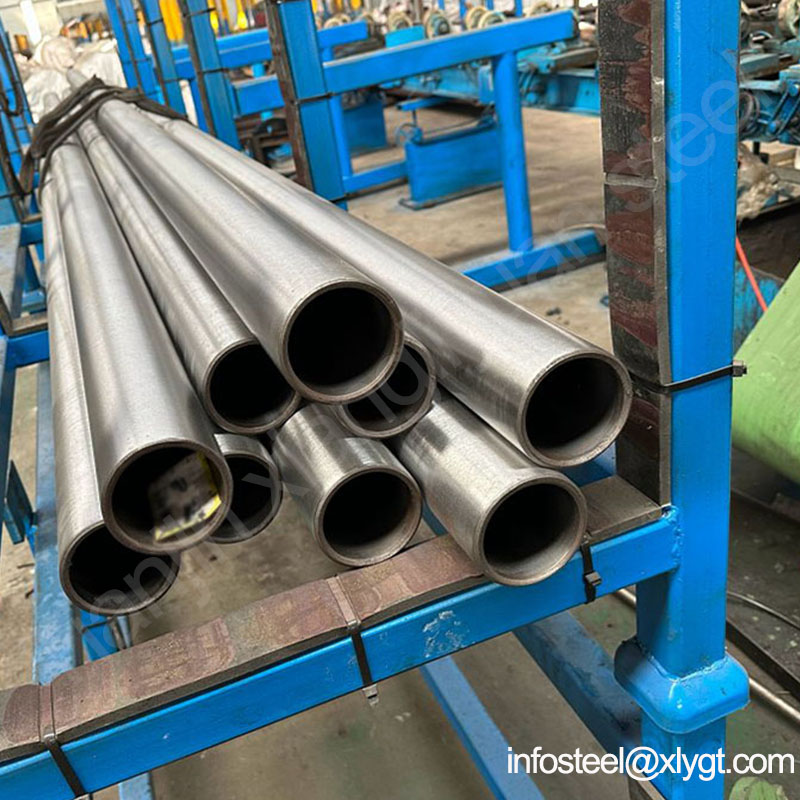
In the world of hydraulic fluid power, the hydraulic cylinder is the actuator converting pressure into linear motion. At the core of this actuator lies the honed tube—a precision-engineered component whose quality directly dictates seal life, energy efficiency, and overall system reliability.
For procurement specialists and engineers at hydraulic cylinder manufacturing plants, sourcing high-quality seamless honed tubes is critical. However, not all tubes are created equal. How do you objectively measure quality? How do you distinguish between a surface that merely looks shiny and one that meets rigorous ISO, DIN, or ASTM standards?
At Tianjin Xiangliyuan Steel, we understand that your brand relies on the performance of our steel. Located in the port city of Tianjin, we have specialized in the export of cold drawn seamless steel tubes and precision honed tubing for over a decade. This guide provides a comprehensive checklist of the key inspection parameters you must verify to ensure you are buying a high-quality honed tube for your hydraulic cylinder.
1. Surface Roughness (Ra) & The Cross-Hatch Pattern
The internal surface is the first line of defense against cylinder failure.
Why it matters:
The inner surface of the tube must retain a microscopic film of oil to lubricate the piston seals. If the surface is too smooth (mirror-like), the oil film collapses, causing friction and seal wear (micro-welding). If it is too rough, the seals are abraded. The gold standard for a hydraulic cylinder tube is a finish that balances roughness with lubricity.
The Technical Standard:
Qualified honing tubes should exhibit a surface roughness (Ra) between 0.2µm and 0.4µm . For high-performance servo cylinders, the requirement may go down to Ra ≤ 0.1µm.
How to Verify:
Do not rely on visual inspection alone. Request a profilometer report.
-
Critical Check: Look for a cross-hatch pattern. This is the distinct lay pattern created by the honing stones. The angle of this pattern (usually 30° to 45°) is crucial for trapping oil. If you see longitudinal scratches (chatter marks) or a chaotic surface, the tube is rejected.
2. Dimensional Precision: ID Tolerance (H7/H8/H9)
A hydraulic cylinder is a precision assembly. The gap between the piston and the tube wall is measured in microns.
Why it matters:
If the Inner Diameter (ID) is too wide, the piston rocks, causing seal extrusion and leakage. If it is too tight, the cylinder seizes or suffers from high starting pressure.
The Technical Standard:
The international standard for precision steel tubes is ISO 286. For cold drawn honed tubes, the industry standard tolerances are:
-
H7: For high-precision or servo cylinders (tightest tolerance).
-
H8: The most common standard for general industrial hydraulic cylinders.
-
H9: Suitable for rough agricultural or pneumatic cylinders .
How to Verify:
The ID tolerance must be consistent across the entire length of the tube. Insert a calibrated air gauge or electronic plug gauge. At Tianjin Xiangliyuan Steel, we control our E355+SR and ST52 tubes to ensure that the H8 tolerance is maintained even after your welding and machining processes, preventing “bore distortion.”
3. Straightness (The Silent Killer of Seals)
Long-stroke cylinders are particularly vulnerable to straightness defects.
Why it matters:
A bent tube causes the piston rod to deflect laterally. This creates uneven loading on the bearings and seals, leading to “piston rod scoring” and rapid internal bypass leakage.
The Technical Standard:
For a standard industrial cylinder, the acceptable deviation is 0.3mm to 0.5mm per running meter . For telescopic cylinders or very long stroke applications, this requirement is often doubled.
How to Verify:
Place the tube on V-blocks on a granite surface plate and measure the deflection using a dial indicator along the axis. Always ask your supplier: Do you perform 100% straightness inspection? At Tianjin Xiangliyuan Steel, our straightening presses and laser alignment tools ensure our seamless precision tubes arrive straight, saving you machining time.
4. Material Traceability & Mechanical Properties
The best surface finish in the world cannot compensate for weak steel. A cylinder operating at 250 bar (3600 psi) requires a tube with specific yield strength.
Why it matters:
Microscopic inclusions or improper heat treatment can lead to “blowouts” or “fishmouth” splitting under pressure. You need seamless steel over welded tubes for high-cycle applications because seamless offers homogeneous grain structure.
The Technical Standard:
Common grades include ST52.3 (DIN 2391), E355 (EN 10305-1), and SAE 1026 (ASTM A519).
-
Yield Strength (ReH): Should be ≥ 520 MPa for ST52 .
-
Hardness: Typically 170–220 HB for machinability.
How to Verify:
Demand an EN 10204 3.1 Material Test Certificate (MTC) . This is a legal document certifying the chemical composition (C, Mn, Si, S, P) and mechanical properties. If a supplier hesitates to provide a MTC, do not buy from them.
5. Ovality & Wall Thickness Tolerance (Eccentricity)
When you machine the outer diameter (OD) or weld flanges to the tube, the wall thickness becomes critical.
Why it matters:
If the tube has high eccentricity (one side of the wall is thick, the other is thin), it will be difficult to machine the OD concentric to the ID. This creates weak spots in the cylinder wall that can rupture under fatigue stress.
The Technical Standard:
For high-quality hydraulic cylinder honed tubes, the eccentricity should be controlled to ±7.5% to ±10% of the nominal wall thickness .
How to Verify:
Cut a cross-section or use an ultrasonic thickness gauge. At Tianjin Xiangliyuan Steel, our cold drawn seamless process inherently produces a more concentric tube than hot-finished alternatives, ensuring uniform wall thickness.
The Tianjin Xiangliyuan Steel Advantage
Selecting a honed tube supplier is a technical partnership. Beyond the parameters listed above, consider the logistics. A delayed shipment can halt your assembly line.
Tianjin Xiangliyuan Steel offers a distinct advantage:
-
Strategic Location: We are headquartered in Tianjin, China. Our proximity to Xingang Port (Tianjin Port) reduces inland logistics costs and loading time. We ship directly to North America, Europe, and Southeast Asia with fast turnaround times.
-
Product Range: We supply Cold Drawn Seamless Tubes (BK/BK+S) and Precision Honed Tubes (SRB/Honed) in grades like ST52, E355, 27SiMn, and SAE 1026 .
-
Quality Assurance: We provide full traceability with EN 10204 3.1 certifications, ensuring compliance with international standards.
Before you place your next order, ask your current supplier: *Can you guarantee H8 tolerance after heat treatment? Do you have a profilometer on-site?*
If the answer is no, contact us.
Visit us: https://www.xlysteel.com/
Email: infosteel@xlygt.com
Tianjin Xiangliyuan Steel – Providing the precision, straightness, and surface finish your hydraulic cylinders demand, shipped directly from the port of Tianjin to your factory floor.