The Critical Role of Precision Tube Manufacturing
In the world of hydraulic systems, the cylinder barrel is not merely a containment vessel; it is the heart of linear motion. The performance, lifespan, and reliability of any hydraulic cylinder—whether used in heavy construction machinery, agricultural equipment, or industrial automation—are directly dictated by the quality of the seamless steel tube at its core.
For international buyers, sourcing hydraulic cylinder honed tubes that meet stringent specifications is challenging. Variations in ID tolerance, surface roughness, and straightness lead to seal failure, energy loss, and catastrophic downtime.
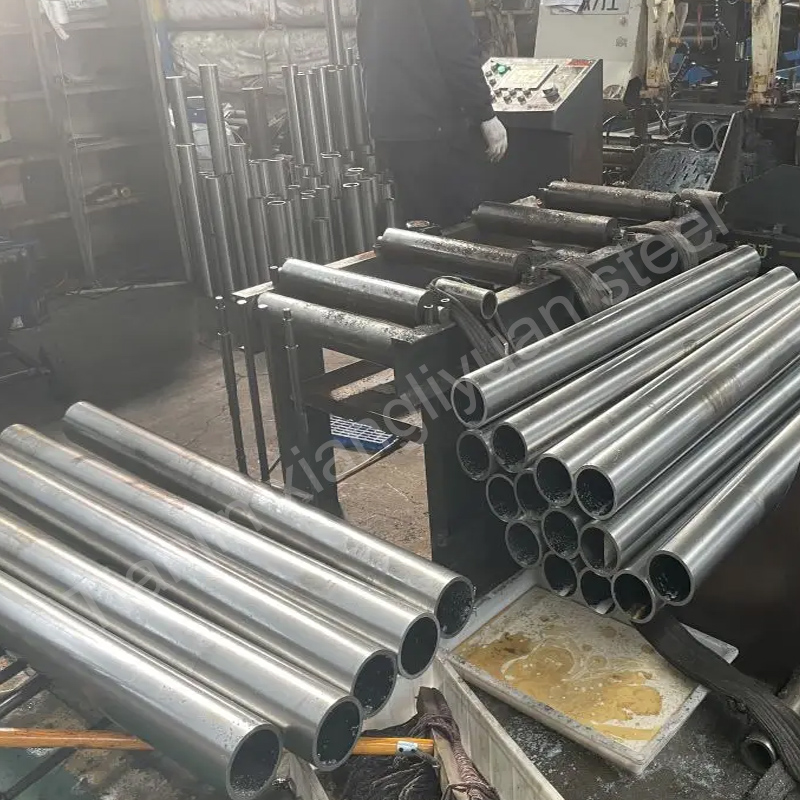
At Tianjin Xiangliyuan Steel, we specialize in the production of high-precision cold drawn seamless tubes and SRB (Skived & Roller Burnished) tubes. Located in the port city of Tianjin, we leverage our logistical advantage—proximity to major shipping ports—to deliver DIN2391, EN10305, and ASTM A519 standard tubes to global clients with rapid turnaround times.
This article provides a technical deep dive into the three non-negotiable specifications of a hydraulic cylinder barrel: ID Tolerance, Surface Roughness (Ra), and Straightness.
1. ID Tolerance (H8, H9, H7 Standards)
When discussing hydraulic cylinder honed tube specifications, the Inner Diameter (ID) tolerance is the most critical factor. It defines the fit between the piston and the tube wall.
The Standard: ISO H8 and H9
The majority of high-quality hydraulic cylinder tubes conform to ISO H8 or H9 tolerances. For higher precision applications, H7 is available.
-
H8 is the industry standard for general hydraulic cylinders, offering a balance between precision and manufacturability.
-
H9 is typically used for larger cylinders or lower-pressure applications.
Technical Data (Based on Cold Drawn Seamless Processing)
At Tianjin Xiangliyuan Steel, we utilize advanced honing and roller burnishing processes to ensure consistent dimensional accuracy across the entire length of the tube. The tolerance range is strictly controlled as follows:
| Inner Diameter (mm) | H7 Tolerance (µm) | H8 Tolerance (µm) | Application Recommendation |
|---|---|---|---|
| 30 – 50 | +25 / 0 | +39 / 0 | High-speed robotics / Servo cylinders |
| 50 – 80 | +30 / 0 | +46 / 0 | General machinery / Agricultural equipment |
| 80 – 120 | +35 / 0 | +54 / 0 | Construction machinery / Excavators |
| 120 – 180 | +40 / 0 | +63 / 0 | Heavy-duty hydraulic presses |
| 180 – 250 | +46 / 0 | +72 / 0 | Mining equipment / Large bore cylinders |
*Data references: DIN 2391 and ISO 286-2 standards .*
Why Precision Matters
A loose ID tolerance leads to blow-by (fluid leaking past the piston seal), reducing volumetric efficiency. Conversely, an ID that is too tight causes scoring and stick-slip motion. Our SRB (Skived and Roller Burnished) process achieves near mirror-finish IDs with tolerances consistently meeting H8, ensuring optimal seal compression and minimal friction.
2. Surface Roughness (Ra ≤ 0.4µm – 0.8µm)
The surface finish of the honed tube is often referred to as the “lubrication pocket.” You cannot simply “polish” a tube; the surface must have a specific cross-hatch pattern to retain hydraulic oil.
The Honing vs. Roller Burnishing Debate
-
Honing (Cutting Process): Uses abrasive stones to remove material. This creates a peak-and-valley structure ideal for oil retention. Standard finish: Ra 0.4µm – 0.8µm.
-
Roller Burnishing (Plastic Deformation): Uses hardened rollers to flatten the surface peaks. This results in a very smooth, work-hardened surface. Standard finish: Ra ≤ 0.2µm (often preferred for high-speed pneumatic cylinders).
Micro-finish Specifications
For standard hydraulic cylinder applications, Tianjin Xiangliyuan Steel recommends and produces a surface roughness of Ra ≤ 0.4µm (max) .
| Process | Surface Roughness (Ra) | Surface Hardness Increase | Material Removal Rate |
|---|---|---|---|
| Honing | 0.2 – 0.4 µm | Minimal | Low (Precision control) |
| Skiving & Roller Burnishing (SRB) | 0.08 – 0.2 µm | 5-10% increase | High (Fast stock removal) |
| Drawing (As-drawn) | 1.0 – 3.0 µm | None | N/A (Unsuitable for seals) |
Table references industry data from hydraulic cylinder manufacturing processes .
The Cross-Hatch Angle (Rmr)
Beyond Ra, we monitor the Rmr (Material Ratio) or bearing area curve. A proper honing angle (typically 30-45 degrees) ensures the hydraulic oil film stays uniform, preventing metal-to-metal contact.
3. Straightness Standards (0.3mm to 1.0mm per meter)
Straightness is the most visible indicator of quality in a seamless cylinder tube. A bent tube will cause uneven wear on piston rods, seals, and guide rings, leading to premature failure.
Industry Standards
While many suppliers offer standard straightness, high-performance hydraulic cylinder tubes require stricter controls:
-
Standard Commercial: 1.0mm per meter.
-
Precision Hydraulic (Our Standard): 0.5mm – 0.8mm per meter.
-
High Precision (Boom cylinders): ≤ 0.3mm per meter.
Manufacturing Influence
Straightness is primarily determined during the cold drawing and heat treatment (normalizing) phases. At Tianjin Xiangliyuan Steel, we employ multi-roller straightening machines that correct residual stresses induced by the cold drawing process.
Why Straightness is Non-Negotiable
If a tube has a straightness deviation of 1.5mm/m over a 2-meter stroke, the lateral force generated is sufficient to destroy the PTFE guide rings within hours of operation. We ensure our honed tubes maintain structural integrity even under high axial loads.
4. Material Chemistry and Mechanical Properties
To understand the steel tube performance, one must look at the chemical composition. We primarily supply ST52 (DIN 2391) and E355 (EN 10305) , known for their excellent weldability and cold working properties.
Case Study: ST52 vs. 20# (SAE 1020)
-
ST52 (1.0570): Contains higher Manganese (≤1.60%) and low Carbon (≤0.22%). Provides superior tensile strength (520-580 MPa) ideal for mobile hydraulics.
-
20# (SAE 1020): Lower strength but excellent toughness, suitable for low-pressure industrial cylinders.
Tianjin Xiangliyuan Steel ensures full material traceability. We can supply 27SiMn, 42CrMo, and CK45 grades for heavy-duty telescopic cylinders used in mining and drilling rigs .
5. The Manufacturing Process: Cold Drawn + Honed / SRB
Our process is designed to solve the common problems of wavy IDs and surface flaking.
-
Raw Material: Seamless steel tubes (Hot rolled).
-
Cold Drawing: The tube is drawn over a mandrel to refine grain structure and achieve initial dimensional accuracy. This improves the mechanical properties of the steel.
-
Heat Treatment: Stress relieving in controlled atmosphere furnaces ensures the steel is stable for machining.
-
Skiving & Roller Burnishing (SRB): In one pass, a skiving head removes the decarburized layer, and rollers burnish the ID. This is faster than honing and leaves a work-hardened surface (crucial for long seal life).
-
Final Inspection: Every tube undergoes air gauging and video borescope inspection to verify ID tolerance and internal surface finish.
Why Tianjin Xiangliyuan Steel?
Choosing the right supplier is about more than just price; it is about Supply Chain Security and Technical Competence.
1. Strategic Location (Tianjin Port)
We are based in Tianjin, China. Our factory is less than 60 kilometers from Tianjin Port, one of the largest and most efficient ports in the world. This geographic advantage translates to:
-
Lower logistics costs for sea freight.
-
Faster lead times (Typically 25–30 days for bulk orders).
-
Reduced risk of overland transit damage.
2. Compliance and Certification
All our hydraulic cylinder honed tubes comply with international standards:
-
DIN 2391 (Germany) – Standard for seamless precision steel tubes.
-
EN 10305-1 (Europe) – Technically equivalent to DIN, with strict surface condition rules.
-
ASTM A519 (USA) – Standard for seamless carbon and alloy steel mechanical tubing.
3. Global Search Relevance
We understand that our clients search for specific solutions. Whether you are looking for “ST52 honed tube for hydraulic cylinder,” “cold drawn seamless tube H8 tolerance,” or “replacement cylinder barrel for excavator,” we have the inventory and manufacturing capacity to meet your needs.
The reliability of your hydraulic equipment begins with the ID tolerance, surface roughness, and straightness of the cylinder tube. By sourcing from a manufacturer that strictly adheres to DIN2391, EN10305, and ASTM A519 standards, you ensure reduced warranty claims and higher customer satisfaction.
At Tianjin Xiangliyuan Steel, we combine over a decade of experience in seamless steel tube manufacturing with the logistical advantages of the Tianjin Port to deliver precision components to the world.
Contact Us for Precision Steel Solutions
Do you have a specific requirement for hydraulic cylinder honed tubes?
-
Email:
infosteel@xlygt.com -
Website: https://www.xlysteel.com/
-
Request a Quote: Send us your ID, OD, Length, Material Grade (e.g., ST52, E355, 27SiMn), and Tolerance Class (H8/H9).
Let us be your long-term partner in the hydraulic industry.