In the global industrial supply chain, selecting the right seamless steel tube is not merely a matter of size and grade; it is a decision that impacts the efficiency, safety, and longevity of your entire project. For engineers, procurement managers, and distributors, understanding the nuanced differences between hot-finished seamless steel tubes and cold-finished seamless steel tubes is critical.
At Tianjin Xiangliyuan Steel, we have spent decades perfecting the metallurgy and logistics of seamless pipe distribution. From our strategic location near the Port of Tianjin—one of the world’s busiest shipping hubs—we ensure that whether you require hot-rolled seamless pipes or precision cold-drawn seamless tubes, your supply chain remains uninterrupted. Contact our technical team at infosteel@xlygt.com or visit https://www.xlysteel.com to explore how our inventory meets API, ASTM, and DIN standards.
This article provides a deep technical analysis of the two primary finishing states of seamless steel tubes, focusing specifically on surface quality and dimensional tolerance—two factors that dictate performance in high-stakes applications like hydraulic systems, boiler tubes, and automotive components.
1. Manufacturing Fundamentals: Heat vs. Cold Reduction
Before analyzing surface and tolerance, one must understand the mechanical journey of the steel.
Hot-Finished Seamless Steel Tubes
The process begins with a solid billet heated to approximately 1200°C–1300°C. Using a rotary piercing mill, the billet is expanded over a mandrel to form a hollow shell. Hot finishing (also known as hot-rolling or hot-sizing) occurs while the steel is in a recrystallized, austenitic phase. The material is then rolled or extruded to final dimensions before cooling.
Cold-Finished Seamless Steel Tubes
Cold finishing starts with a hot-finished tube as the mother blank. The tube is pickled (to remove scale), lubricated, and then pulled through a die and over a plug at ambient temperature. This cold drawing process reduces the diameter and wall thickness simultaneously. To relieve work hardening, the tube may undergo several passes with intermediate annealing.
2. Surface Quality Analysis: Scale, Roughness, and Defects
For international buyers, surface quality is the first indicator of manufacturing integrity.
Hot-Finished Surface Characteristics
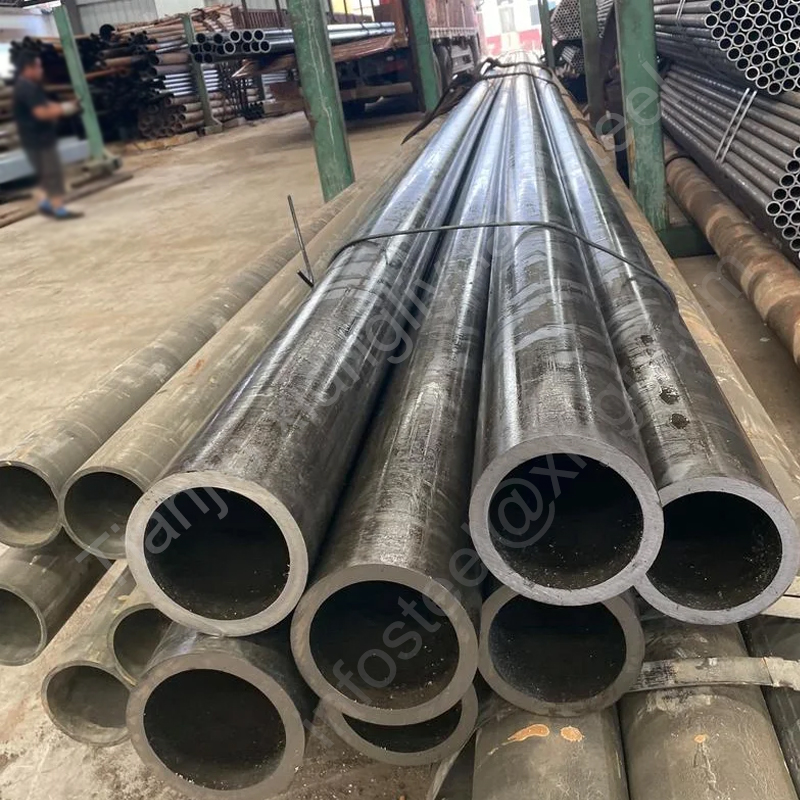
Due to high-temperature processing, hot-finished seamless tubes inevitably develop a layer of iron oxide (mill scale) on the outer and inner surfaces. This scale is dark, rough, and slightly adherent. While the base metal is sound, the surface finish is typically matte and coarse (Ra values generally range from 3.2 to 12.5 µm).
Pros of Hot-Finished Surface:
-
Suitable for non-cosmetic structural applications (pilings, scaffolding, line pipes).
-
Lower manufacturing cost per ton.
Cons:
-
Requires additional pickling, machining, or grinding if used for hydraulic or bearing applications.
-
Scale can flake off, contaminating fluid systems.
Cold-Finished Surface Characteristics
Cold finishing dramatically improves surface integrity. The cold drawing process burnishes the surface, breaking up scale and closing microscopic voids. The result is a bright, smooth, oxide-free surface with Ra values typically between 0.4 and 1.6 µm.
Pros of Cold-Finished Surface:
-
Ideal for precision steel tubes used in hydraulic cylinders, shock absorbers, and pneumatic systems.
-
No secondary processing required for painting or coating adhesion.
-
Lower friction coefficients for moving parts.
Expert Insight from Tianjin Xiangliyuan Steel:
We frequently advise oil & gas clients that while hot-finished API 5L pipes are cost-effective for transmission lines, their cold-finished seamless counterparts are mandatory for downhole tools where surface defects lead to hydrogen-induced cracking (HIC). For specifications requiring a flawless surface, trust our cold-drawn stock. Verify our certifications at https://www.xlysteel.com.
3. Dimensional Tolerance Analysis: The Precision Gap
Dimensional accuracy is where the difference between hot and cold finishing becomes stark. Global standards (ASTM A519, EN 10216, DIN 2391) define distinct tolerance classes.
Hot-Finished Tolerances
Because hot working involves thermal expansion and contraction, controlling final dimensions to tight margins is challenging. Per ASTM A106, a hot-finished seamless carbon steel pipe of 4” NPS (114.3mm OD) has an outside diameter tolerance of +1.6% / -0.8% (approx. ±1.8mm). Wall thickness tolerances are even looser, typically ±12.5% to ±15% of nominal.
Practical implication: If your design requires a close sliding fit or precise threading, hot-finished tubes often require external machining.
Cold-Finished Tolerances
Cold drawing is a precision process. Tolerances for cold-drawn seamless tubes are 5 to 10 times tighter than hot-finished. For example, DIN 2391 Grade C (cold-finished) allows OD tolerances of ±0.1mm for diameters under 50mm. Wall thickness can be held to ±5% or better.
Key benefits for international buyers:
-
Material savings: Tighter walls reduce weight without compromising burst pressure.
-
Machining reduction: Many cold-finished tubes are ready for use as-manufactured in hydraulic cylinders.
-
Consistent ID: Critical for telescopic booms and thin-wall heat exchangers.
Why this matters to your supply chain:
A European manufacturer of agricultural rams once replaced hot-finished tubes with our cold-finished stock and reduced his honing costs by 40%. We provided the exact seamless precision tube with a guaranteed 0.05mm ID tolerance. Ask for our tolerance chart at infosteel@xlygt.com.
4. Mechanical Property Shifts: Strength vs. Ductility
Surface and tolerance are visible; mechanical changes are hidden but vital.
Hot-Finished Properties
Because no cold work remains (the steel recrystallizes during cooling), hot-finished tubes are in an annealed or normalized condition. They offer:
-
High ductility and impact resistance.
-
Lower yield strength compared to cold-worked variants.
-
Excellent weldability and formability.
Cold-Finished Properties
Cold drawing introduces work hardening (dislocation density increase). As the tube diameter reduces, its tensile strength rises by 20–40% compared to the hot-finished blank. However, ductility (% elongation) decreases.
Note: For most structural codes, cold-finished tubes can be stress-relieved (heated below recrystallization) to restore ductility while retaining tight tolerances.
Recommendation from Tianjin Xiangliyuan Steel:
If your application involves bending, flanging, or swaging, a hot-finished seamless tube is safer. If you need a high-strength, wear-resistant bore with minimal machining, choose cold-finished seamless steel tubes. We maintain dual inventories at our Tianjin warehouse to serve both needs.
5. Cost, Lead Time, and Logistics: The Tianjin Advantage
Your budget and delivery schedule are as important as metallurgy.
Cost Comparison
-
Hot-finished: Lower manufacturing cost (fewer steps, higher throughput). Typically 15–25% cheaper per ton than cold-finished.
-
Cold-finished: Higher cost due to pickling, annealing, drawing, and straightening. But often reduces your total cost of ownership by eliminating secondary machining.
The Tianjin Xiangliyuan Steel Logistic Edge
Located in the Tianjin Economic-Technological Development Area, we are literally minutes from the Tianjin Port—one of China’s largest comprehensive ports. While other suppliers waste time on inland trucking, our seamless steel pipe export process is streamlined:
-
Direct truck-to-ship loading reduces handling damage to surface finishes.
-
Weekly LCL and FCL consolidation to North America, Europe, Southeast Asia, and the Middle East.
-
Real-time tracking from our mill partners to your destination port.
We combine the quality of hot-rolled seamless tubes for infrastructure projects with the precision of cold-drawn seamless tubes for OEMs, all backed by a logistics team that understands demurrage and customs clearance. Visit https://www.xlysteel.com for our latest lead times.
6. Application Matrix: Which Tube Wins?
Based on surface quality and tolerance needs, here is our guide for international buyers.
| Application | Recommended Type | Rationale |
|---|---|---|
| High-pressure hydraulic lines | Cold-finished seamless | Smooth ID reduces turbulence; tight OD fits fittings. |
| Boiler tubes (superheaters) | Hot-finished / Cold-finished normalized | Creep resistance at high temp; tight tolerances for finning. |
| Structural piles (offshore) | Hot-finished seamless | Cost-effective; mill scale offers temporary corrosion protection. |
| Precision shafts / Mandrels | Cold-finished seamless (stress-relieved) | Concentricity and straightness under 0.2mm/m. |
| Oil country tubular goods (OCTG) | Hot-finished (quenched & tempered) | Heavy walls tolerate threading and downhole stress. |
| Automotive steering components | Cold-finished seamless | Surface integrity for dynamic fatigue loads. |
Disclaimer: Final selection requires analysis of working pressure, temperature, and media. Contact our engineers for a free specification review.
7. Quality Assurance and Compliance
At Tianjin Xiangliyuan Steel, we do not guess—we certify. All our seamless steel tubes undergo:
-
Chemical analysis (Spectrometer per ASTM E415).
-
Tensile and flattening tests (Per ASTM A370).
-
Flaw detection (Ultrasonic and Eddy current for cold-finished lines).
-
Dimensional inspection (Laser micrometers for OD; pin gauges for ID).
We supply to global standards including:
-
ASTM A106/A53 (Hot-finished carbon)
-
ASTM A519 (Cold-drawn mechanical)
-
DIN 2391/EN 10305 (Precision seamless)
-
API 5L (Line pipe)
Every shipment includes an EN 10204 Type 3.1 certificate. For third-party inspections (SGS, BV, Lloyds), we offer full cooperation. Our track record speaks through repeat contracts from German auto suppliers to Canadian oil sands operators.
8. Making the Right Choice for Your ROI
Choosing between hot-finished and cold-finished seamless steel tubes is not about which is better—it is about which is appropriate for your tolerance, surface, and budget requirements.
-
Choose hot-finished when cost, large diameters, and ductility are your priorities, and surface finish will be hidden or machined.
-
Choose cold-finished when precision tolerances, smooth surfaces, and enhanced mechanical properties drive your design.
As a supplier rooted in Tianjin’s industrial heartland, Tianjin Xiangliyuan Steel leverages our port proximity to deliver both options globally with competitive freight rates. We do not just sell pipes; we provide supply chain solutions that reduce your inventory holding costs and machining waste.
Ready to specify your next seamless steel tube order?
-
📧 Send your RFQ to infosteel@xlygt.com
-
🌐 Browse our technical library at https://www.xlysteel.com
-
🚢 Request a logistics quote from Tianjin Port to your nearest port
Let us help you move from specification to delivery—efficiently, accurately, and professionally.