Navigating Global Standards for Hollow Sections
In the world of structural steel construction, choosing the right material specification is not merely a matter of preference—it is a critical engineering decision that impacts safety, fabrication costs, and project approval. For procurement specialists and engineers sourcing Carbon Steel Structural Tubing globally, the two dominant standards are the European EN 10219 and the American ASTM A500.
While both govern Cold-Formed Welded Structural Hollow Sections (CHS, SHS, and RHS) , they diverge significantly in philosophy, chemical composition, mechanical properties, and tolerance regimes. At Tianjin Xiangliyuan Steel, we specialize in manufacturing and exporting High-Frequency Welding (HFW) steel tubes compliant with both standards.
Leveraging our strategic location in Tianjin Port—one of the world’s busiest shipping hubs—we ensure efficient, logistics-optimized delivery of ERW Steel Pipe to North America, Europe, and beyond. This technical guide provides a rigorous, clause-by-clause comparison to assist engineers in selecting the correct Hollow Section for their specific design code.
1. Scope and Manufacturing Philosophy
ASTM A500 (American Standard)
ASTM A500 covers cold-formed welded and seamless carbon steel tubing in round, square, and rectangular shapes. It is the primary standard for Structural Steel Pipe used in buildings, bridges, and sign poles in the US market. Notably, it permits the seamless manufacturing process, although welded tubing is the most common economic choice.
EN 10219 (European Standard)
EN 10219-1/2 applies strictly to cold-formed welded structural hollow sections of non-alloy and fine-grain steels. Unlike its hot-finished counterpart (EN 10210), or ASTM A500, this standard explicitly excludes seamless pipes. It is harmonized with the Eurocode 3 design framework, meaning the material properties align specifically with the calculation methods required for European construction projects.
Key Takeaway for Sourcing:
If a project specifies a seamless process, ASTM A500 may be an option, but EN 10219 requires a welded process (typically ERW or HFW), which offers tighter geometric consistency.
2. Chemical Composition and Steel Grades
The grading nomenclature reveals the underlying design logic: ASTM focuses on Tensile Strength, while EN focuses on Yield Strength and Toughness.
ASTM A500 Grades
-
Grade B: The workhorse (Min Yield: 46 ksi / 317 MPa; Min Tensile: 58 ksi / 400 MPa).
-
Grade C: High-strength option (Min Yield: 50 ksi / 345 MPa; Min Tensile: 62 ksi / 427 MPa).
-
Chemistry: Limits are broader. Carbon (C) max is generally 0.26% for Grade C. There is no mandatory requirement for low-temperature impact testing unless specified by the purchaser.
EN 10219 Grades
-
S235JRH, S275J0H, S355J2H: The suffix indicates impact toughness temperature (e.g., J2 = 27J at -20°C).
-
S355J2H: The most common grade (Min Yield: 355 MPa; Min Tensile: 470-630 MPa). Note the superior yield strength compared to ASTM A500 Gr. C (355 MPa vs 345 MPa).
-
Chemistry: Stricter control. For S355J2H, max Carbon Equivalent (CEV) is often specified to ensure weldability, and max Phosphorus (P) and Sulfur (S) are lower (0.035% max) than ASTM A500.
SEO Keyword Focus: *High-strength steel tubing, S355J2H mechanical properties, ASTM A500 Grade C equivalent, Carbon steel chemical composition.*
3. Mechanical Properties and Toughness (The Critical Divergence)
This is the most significant difference between EN 10219 and ASTM A500.
Impact Testing
-
ASTM A500: Contains a cautionary note. Unless specified by the supplementary requirement S3, impact testing is not performed. This makes standard A500 potentially unsuitable for seismic zones or low-temperature environments (-20°C and below).
-
EN 10219: Mandates Charpy V-Notch (CVN) impact testing for specific grades (J0, J2, K2). For example, S355J2H guarantees 27J at -20°C. This is mandatory for Low-Temperature Service and Offshore Structures.
Elongation
-
ASTM A500 Gr. B/C: Minimum elongation is 23% (Gr. B) and 21% (Gr. C) in 2 inches. This is measured longitudinally.
-
EN 10219 S355J2H: Requires 20% elongation on a 5.65 √So gauge length. The difference in gauge length calculation makes direct comparison difficult, but EN generally maintains ductility alongside higher yield strength.
Why this matters for your project:
For a bridge construction or a crane runway in Northern Europe or Canada, EN 10219’s mandatory toughness makes it the safer choice. For a static warehouse rack in a warm climate, ASTM A500 is economical.
4. Dimensional Tolerances (Precision Matters)
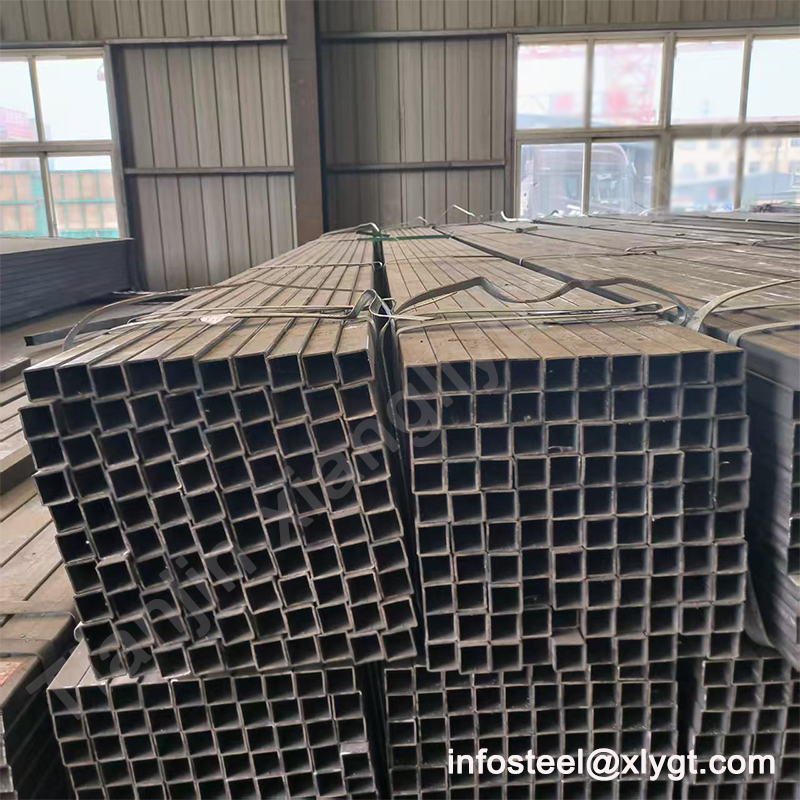
At Tianjin Xiangliyuan steel, we utilize advanced Cold Forming lines to ensure our Rectangular Hollow Sections (RHS) and Square Hollow Sections (SHS) meet the strictest requirements. Here is the technical breakdown:
Wall Thickness Tolerances
-
ASTM A500: Generally ±10% of nominal thickness. However, a specific deviation is allowed at the weld seam, which can result in localized thinning.
-
EN 10219: More refined:
±0.1tfort ≤ 5mmand±0.5mmfort > 5mm(or ±10%, capped).-
Result: EN 10219 generally offers tighter control, reducing weight variation.
-
Corner Radii (for RHS/SHS)
-
ASTM A500: Specifies a maximum inside corner radius (
< 3t). Designers often must assume a larger radius for safety. -
EN 10219: Specifies exact limits (e.g.,
1.6tto2.4tfort ≤ 6mm). This allows for more precise engineering of Architectural Structures and connection detailing.
Twist and Straightness
-
ASTM A500: Twist tolerance is based on size, e.g.,
2.09 mm/mfor 100mm sections. Straightness isL/480. -
EN 10219: Twist is
2 mm + 0.5mm/m. Straightness for RHS isL/667(stricter than A500).
SEO Keyword Focus: *Square tube corner radii, EN 10219 dimensions, ASTM A500 tolerances, Cold-formed rectangular hollow section.*
5. Certification and Traceability
Mill Test Certificates (MTC)
-
EN 10219: Often requires EN 10204 Type 3.1 (independent inspection) or 3.2 (third-party witness). Traceability is heat-based and rigorous.
-
ASTM A500: Typically supplied with EN 10204 Type 2.2 (documentation without inspection).
If your project requires CE Marking or compliance with the Construction Products Regulation (CPR) , EN 10219 is mandatory. ASTM A500 alone is insufficient for European regulatory approval.
6. Practical Application Guide: Which to Choose?
When consulting for global Oil and Gas or EPC projects, use this matrix:
| Condition | Recommendation | Why? |
|---|---|---|
| Project Location: USA, Canada, Mexico | ASTM A500 | Local code familiarity; AISC manual compatibility. |
| Project Location: Europe, UK, Australia | EN 10219 | Compliance with Eurocode; Requires CE Marking. |
| Requirement: Low Temperature (-20°C) | EN 10219 (J2/K2) | Guaranteed impact resistance; ASTM A500 requires costly supplementary testing. |
| Requirement: Fatigue / Dynamic Loading | EN 10219 | Tighter tolerances and weld quality reduce stress risers. |
| Budget Constraint / Bulk Structural | ASTM A500 Gr. B | Wider tolerances yield higher production rates; cost-effective for non-critical framing. |
Why Tianjin Xiangliyuan Steel is Your Optimal Partner
Navigating these standards is only half the battle. You need a manufacturer who can execute both specifications without compromising delivery.
At Tianjin xiangliyuan steel, we bridge the gap between the European and American standards. Our production lines are certified to produce Cold-Formed Welded Tubes ranging from 20x20mm to 500x500mm, with wall thicknesses up to 16mm, meeting ASTM A500, EN 10219, and AS 1163 standards concurrently.
Our Competitive Advantages:
-
Dual-Certified Stock: We maintain inventory of S355J2H / Gr. B dual-certified pipes. One material stock serving both EU and US projects.
-
Logistics Excellence: Located in Tianjin, our factory is less than 30km from the Tianjin Port. This drastically reduces inland logistics costs and ensures rapid FOB Tianjin shipping schedules.
-
Quality Assurance: Every ERW Steel Pipe undergoes continuous non-destructive testing (NDT) and hydrostatic testing (when requested). We provide full traceability reports conforming to EN 10204 3.1.
We understand that replacing a Process Pipe (for fluids) with a structural pipe is dangerous, and mixing up A500 and EN 10219 can lead to engineering liability. Our technical sales team is trained to verify your Hollow Section requirements before production.
Contact Us for Your Next Project
Do you need a Structural Steel Pipe supplier who speaks both “Eurocode” and “AISC”? Send us your inquiry.
-
Website: https://www.xlysteel.com/
-
Email:
infosteel@xlygt.com
Let us optimize your supply chain for Structural Hollow Sections—whether you need the brute strength of ASTM A500 Gr. C or the low-temperature toughness of EN 10219 S355J2H.
References & Further Reading:
-
*ASTM A500 / A500M – Standard Specification for Cold-Formed Welded and Seamless Carbon Steel Structural Tubing.*
-
*EN 10219-1:2006 – Cold formed welded structural hollow sections of non-alloy and fine grain steels.*
-
AISC 360 – Specification for Structural Steel Buildings.