Navigating Global Flange Standards for Industrial Piping Systems
In the world of carbon steel pipe fittings and industrial pipeline engineering, the connection is often the weakest link—or the strongest asset. For procurement managers and project engineers working on international infrastructure, the debate between ASME B16.5 vs. EN 1092-1 is not merely academic; it is a daily operational hurdle.
Mis-matching these two dominant pipe flange standards can lead to catastrophic leaks, project delays, and budget overruns. At Tianjin Xiangliyuan Steel, we specialize in supplying high-quality forged steel flanges that strictly adhere to these international norms. As a leading supplier based in the Tianjin port area, we understand that compliance with pressure-temperature ratings is the cornerstone of safety and performance.
This article provides a technical deep dive comparing the pressure rating methodologies of ASME B16.5 (American standard) and EN 1092-1 (European standard). We aim to clarify why these two systems are fundamentally non-interchangeable and how to select the correct pipeline flanges for your specific operating conditions.
1. The Fundamental Frameworks: Class vs. PN
Before comparing numbers, one must understand the philosophical difference between the two systems.
ASME B16.5 covers steel pipe flanges from NPS 1/2” to NPS 24”. It utilizes the “Class” system (150, 300, 600, 900, 1500, 2500). Crucially, the “Class” is not a measurement of pressure but a dimensionless designator. A Class 150 flange is not rated for 150 psi; it is rated for approximately 285 psi at ambient temperatures, depending on the material group .
EN 1092-1 covers flanges from DN 10 to DN 4000. It uses the “PN” (Nominal Pressure) system (PN 2.5 to PN 400). Unlike ASME, the PN number generally corresponds to the maximum working pressure in bars at 20°C (68°F). For example, a PN 16 flange has a max allowable pressure of 16 bars at ambient temperature .
2. Technical Deep Dive: Pressure-Temperature Ratings
The most significant divergence between ASME B16.5 and EN 1092-1 lies in how pressure de-rates as temperature increases.
ASME B16.5 Methodology
ASME B16.5 bases its ratings on the material group (e.g., Group 1.1 for Carbon Steel ASTM A105). The allowable working pressure drops significantly at elevated temperatures. For a standard carbon steel flange (ASTM A105):
-
At 100°F (38°C): A Class 150 flange is rated for ~285 psi (19.6 bar).
-
At 600°F (315°C): The rating drops to ~140 psi (9.6 bar) .
The ASME system is highly granular, accounting for creep and oxidation in the high-temperature steel grades often used in petrochemical plants.
EN 1092-1 Methodology
EN 1092-1 provides a simpler de-rating curve based on the material’s yield strength at temperature. For a common P250GH carbon steel flange (equivalent to ASTM A105):
-
At 50°C (122°F): A PN 16 flange is rated at maximum allowable pressure (16 bar).
-
At 300°C (572°F): The rating may drop to as low as 11.3 bar, depending on the specific material certificate .
Critical Insight for Engineers:
It is a dangerous myth that Class 150 is equivalent to PN 16. While the intended service pressure is similar, the dimensions (bolt circle, diameter) and the temperature de-rating curves are different. If you try to bolt a Class 150 flange to a PN 16 flange, you will experience gasket failure due to mismatched raised face heights and bolt patterns .
3. Dimensional Interchangeability: A Zero-Sum Game
While this article focuses on pressure, we cannot ignore the structural integrity determined by dimensions. Tianjin Xiangliyuan Steel strictly advises clients against attempting to mix these systems without an adapter.
Here is a comparison of a Weld Neck Flange for a 6-inch / DN150 pipeline:
| Parameter | ASME B16.5 Class 150 | EN 1092-1 PN 16 |
|---|---|---|
| Flange Outer Diameter (OD) | 279.4 mm | 285 mm |
| Bolt Circle Diameter | 241.3 mm | 240 mm |
| Bolt Hole Size | 22.4 mm | 22 mm |
| Raised Face (RF) Height | 1.6 mm (1/16”) | 2.0 mm |
Data source: Industry standards comparison .
Although the bolt count (8) matches, the 1.3mm difference in the bolt circle makes alignment impossible without re-drilling—a practice that voids the pressure rating certification. The 0.4mm difference in RF height means the gasket pressure will be uneven, leading to leaks in high-pressure gas lines.
4. Material Cross-reference and Equivalents
For global sourcing, understanding material equivalents is vital for cost estimation and supply chain flexibility. Tianjin Xiangliyuan Steel maintains inventory in both ASTM and EN specifications to serve diverse markets.
| Application | ASME (USA) | EN 1092-1 (Europe) | Key Properties |
|---|---|---|---|
| Carbon Steel (Low Temp) | A105 | P250GH / 1.0460 | Standard for oil, water, and steam |
| Carbon Steel (Low Temp) | A350 LF2 | P275NH / 1.0487 | Impact tested for cold climates |
| Stainless Steel (304) | A182 F304 | X5CrNi18-10 / 1.4301 | Corrosion resistance |
| Stainless Steel (316) | A182 F316 | X5CrNiMo17-12-2 / 1.4401 | Saltwater/chemical resistant |
While ASTM A105 and EN P250GH have similar chemical compositions, their allowable stress values at high temperatures differ slightly due to different safety factors applied by the codes . When ordering butt weld fittings or flanges for a European spec project, always insist on EN 10204 3.1 material certification to ensure full traceability.
5. Practical Procurement and Logistics
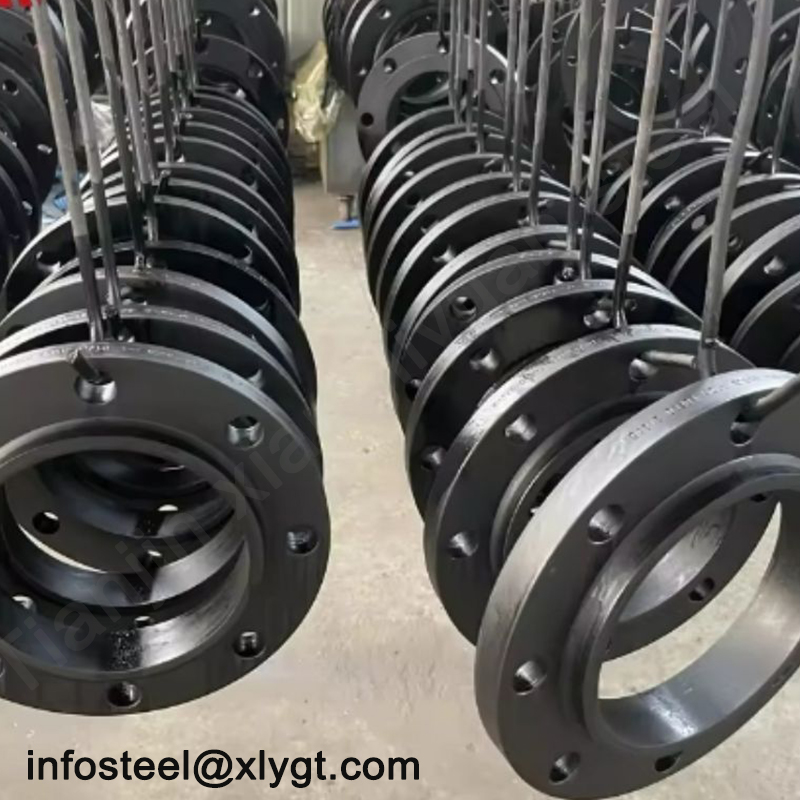
As a supplier based in Tianjin, China, we leverage our proximity to one of the world’s busiest ports to deliver these critical components efficiently. Whether you require slip-on flanges, blind flanges, or long weld neck flanges for heat exchanger applications, understanding the standard is the first step.
For ASME B16.5 Projects:
-
Specify the NPS (Nominal Pipe Size) and Schedule (e.g., NPS 4 Sch 40).
-
State the ASTM material grade.
-
Confirm if facing is Raised Face (RF) or Ring Type Joint (RTJ) for high-pressure lines.
For EN 1092-1 Projects:
-
Specify the DN (Diameter Nominal) and PN rating.
-
Define the flange Type (e.g., Type 11 for Weld Neck, Type 01 for Plate).
-
Confirm the facing (Type B for RF, Type A for FF) .
6. Why Supply Chain Proximity Matters
The weight and volume of steel flanges make logistics a primary cost driver. Shipping 20 tons of carbon steel blind flanges from inland China adds significant trucking fees before the ocean freight even begins.
Tianjin Xiangliyuan Steel operates near the Tianjin Port, one of the largest comprehensive ports in Northern China. This strategic location offers:
-
Reduced Inland Freight: We save you money on trucking to the vessel.
-
Flexible Lead Times: Loading can often be completed within 24 hours of order release.
-
Quality Control: Our NDT (Non-Destructive Testing) facilities, including ultrasonic testing (UT) and magnetic particle inspection (MT), ensure your forged steel flanges meet both ASME and PED (Pressure Equipment Directive) standards before they leave the dock.
7. Conclusion and Recommendation
Choosing between ASME B16.5 and EN 1092-1 comes down to the design code of your project. For projects in the Americas, the Middle East, or Asia following US standards, ASME is mandatory. For European projects or those under the PED directive, EN 1092-1 is required.
Key takeaways:
-
Do not mix: You cannot bolt ASME Class 150 to EN PN 16 and expect a seal.
-
Check temperature: Always consult the specific pressure-temperature rating chart for your specific material grade; generic ratings are dangerous.
-
Source smartly: Work with a supplier who understands both systems to avoid costly errors.
At Tianjin Xiangliyuan Steel, our engineers are fluent in both ASME and EN standards. We provide slip-on flanges, weld neck flanges, and custom steel pipe fittings with full material traceability. Contact us to discuss your next project.
Contact Tianjin Xiangliyuan Steel Today
For inquiries on stock availability, custom dimensions, or urgent shipping quotes from Tianjin Port, please reach out to us.
-
Company: Tianjin Xiangliyuan Steel Co., Ltd.
-
Email:
infosteel@xlygt.com -
Website:
https://www.xlysteel.com/
Optimize your pipeline integrity with certified materials. We look forward to being your trusted partner in the steel industry.