Why Steel Pipe Testing Matters
In the global infrastructure landscape, steel pipes serve as the backbone of critical applications—from oil and gas transmission lines to power generation facilities, chemical processing plants, and structural frameworks. The integrity of these pipes directly impacts operational safety, environmental protection, and long-term project economics. At Tianjin Xiangliyuan Steel (https://www.xlysteel.com/), we understand that comprehensive testing protocols are not merely regulatory checkboxes; they represent our commitment to delivering products that perform reliably under the most demanding conditions.
Located in Tianjin, China’s premier port city with direct access to Tianjin Port—one of the world’s busiest maritime hubs—we combine rigorous quality assurance with strategic logistics advantages. Our proximity to the port enables faster delivery times and reduced shipping costs for international clients across Europe, the Middle East, Africa, Southeast Asia, and the Americas. For technical consultations or procurement inquiries, reach our engineering team at infosteel@xlygt.com.
This guide examines the complete spectrum of steel pipe testing methodologies, from destructive laboratory analyses to advanced non-destructive evaluation techniques employed by leading manufacturers worldwide.
Understanding Testing Classifications
Steel pipe testing divides into two fundamental categories: Destructive Testing (DT) and Non-Destructive Testing (NDT). Each serves distinct purposes within quality assurance frameworks.
Destructive Testing involves subjecting sample specimens to stresses that permanently alter or damage the material. These methods provide definitive data on mechanical properties but sacrifice the tested samples. Non-Destructive Testing, conversely, evaluates pipe integrity without compromising usability—essential for 100% inspection coverage of production lots .
Non-Destructive Testing (NDT) Methods
NDT represents the cornerstone of modern pipe quality control, enabling manufacturers to detect internal and surface defects while maintaining product usability. Industry statistics indicate ultrasonic testing alone accounts for approximately 23% of the global NDT market, reflecting its critical importance in pipeline infrastructure .
Ultrasonic Testing (UT)
Ultrasonic Testing employs high-frequency sound waves (typically 0.5–25 MHz) transmitted through the pipe material. When sound waves encounter discontinuities—cracks, voids, or inclusions—they reflect back to the transducer, creating detectable echoes that reveal defect location, size, and orientation .
Key Applications:
Wall thickness measurement for corrosion monitoring
Weld seam integrity verification
Detection of laminations and internal cracks
Advanced Variants:
Phased Array Ultrasonic Testing (PAUT): Provides detailed, real-time imaging with electronic beam steering, significantly improving detection accuracy and inspection speed .
Time-of-Flight Diffraction (TOFD): Offers precise defect sizing capabilities, particularly effective for crack depth measurement.
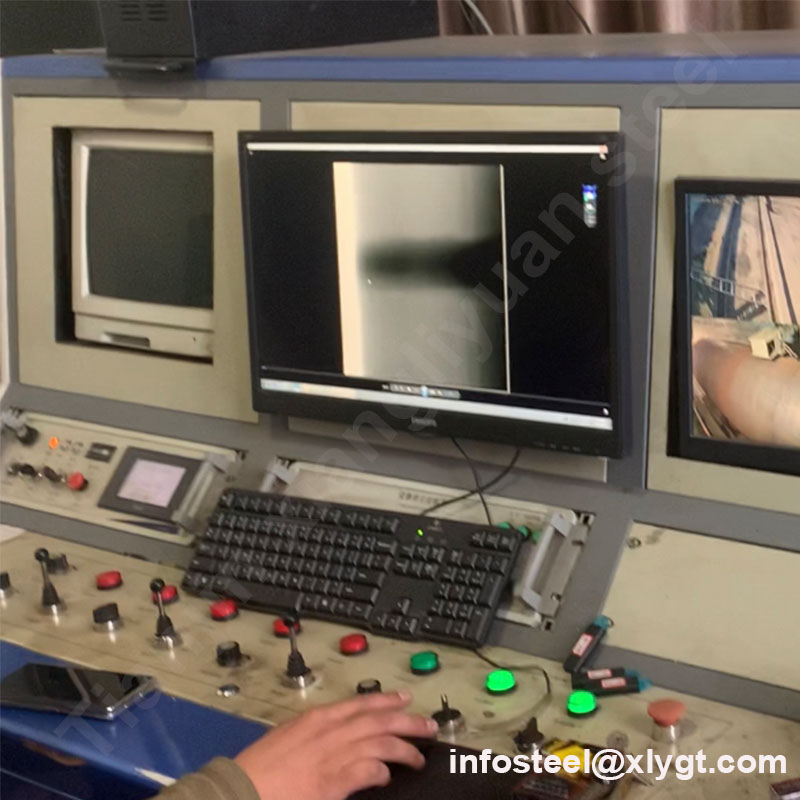
At Tianjin Xiangliyuan Steel, our automated UT systems inspect 100% of longitudinal and spiral welds, ensuring compliance with API 5L, ASTM A53, ASTM A672, and EN 10217 standards.
Radiographic Testing (RT)
Radiographic Testing utilizes X-rays or gamma rays (commonly Iridium-192 or Cobalt-60) to penetrate pipe walls and create images on digital detectors or film. This volumetric inspection method reveals internal defects invisible to surface examination techniques .
Detectable Defects:
Slag inclusions and porosity in welds
Incomplete penetration or fusion
Internal cracks and cavities
Digital Radiography (DR) has revolutionized this field, offering faster processing times, lower radiation doses, and enhanced image quality compared to conventional film methods. DR eliminates chemical processing requirements and provides immediate digital records for quality documentation .
According to ASTM A671 and ASTM A672 specifications for electric fusion welded pipes, radiographic examination of weld seams ensures compliance with pressure vessel and pipeline applications requiring the highest integrity levels .
Magnetic Particle Testing (MT)
Magnetic Particle Testing applies to ferromagnetic materials—primarily carbon steel and low-alloy steel pipes. The process involves magnetizing the pipe section and applying ferromagnetic particles (dry or suspended in liquid). Surface and near-surface discontinuities disrupt the magnetic field, creating visible particle accumulations that indicate defect locations .
MT excels at detecting:
Surface cracks in weld seams
Fatigue cracks in high-stress areas
Grinding cracks and processing defects
This method offers cost-effectiveness and operational simplicity, making it ideal for routine production-line inspections and field maintenance evaluations .
Eddy Current Testing (ECT)
Eddy Current Testing uses electromagnetic induction to detect surface defects and material property variations in conductive metals. An alternating current coil generates changing magnetic fields that induce circulating currents (eddies) in the pipe material. Discontinuities alter eddy current flow patterns, producing measurable impedance changes .
ECT proves particularly valuable for:
Detecting surface cracks and corrosion pits
Sorting materials based on conductivity
Measuring coating thickness and conductivity variations
Penetrant Testing (PT)
Liquid Penetrant Testing applies colored or fluorescent dye to clean pipe surfaces. Capillary action draws penetrant into surface-breaking defects. After excess removal, a developer draws the trapped penetrant to the surface, creating visible indications under appropriate lighting conditions .
PT effectively identifies surface cracks, porosity, and leaks in non-porous materials, complementing other NDT methods for comprehensive quality verification.
Acoustic Emission Testing (AE)
Acoustic Emission Testing monitors high-frequency stress waves generated by material deformation or crack propagation. Unlike other NDT methods requiring external energy input, AE detects energy released by the material itself—enabling continuous structural health monitoring .
AE testing can detect microcrack growth at fractions of millimeter precision, offering up to 30% cost savings compared to conventional inspection methods while identifying 90% of significant defects in monitored pipeline systems .
Destructive Testing (DT) Methods
While NDT ensures production quality, Destructive Testing validates material properties through standardized mechanical and chemical analyses. These tests require representative samples sacrificed during evaluation.
Tensile Testing
Tensile testing subjects machined specimens to controlled tension until fracture, measuring:
Yield Strength: The stress at which permanent deformation begins
Tensile Strength: Maximum stress the material withstands
Elongation: Ductility measured as percentage of original length
Reduction of Area: Cross-sectional contraction at fracture point
ASTM A370 and ISO 6892 establish standardized procedures for these evaluations. For API 5L line pipes and ASTM A672 pressure pipes, tensile properties must meet strict minima varying by grade designation .
Charpy V-Notch Impact Testing
Impact testing evaluates material toughness—the ability to absorb energy during sudden loading. Standardized specimens with machined V-notches undergo pendulum impact at specified temperatures. Results indicate susceptibility to brittle fracture, critical for low-temperature service applications .
API 5L and ASTM specifications mandate impact testing for pipes intended for sour service, offshore environments, or subzero operating temperatures.
Hardness Testing
Hardness measurements—Rockwell (HRC/HRB), Brinell (HBW), or Vickers (HV)—correlate with strength and wear resistance. Excessive hardness in welded regions may indicate brittle microstructures susceptible to hydrogen-induced cracking (HIC) or sulfide stress cracking (SSC) in sour service environments.
Bend Testing
Guided bend tests evaluate weld ductility and soundness. Specimens bend around a mandrel of specified radius, with the weld positioned at maximum stress points. Acceptance criteria require no cracks exceeding defined dimensions on the tension surface .
Chemical Analysis
Spectrographic analysis verifies elemental composition against specification requirements. Carbon, manganese, silicon, sulfur, phosphorus, and alloying element concentrations determine weldability, strength, and corrosion resistance. Ladle analysis and product analysis ensure consistency from heat to finished pipe .
Metallographic Examination
Microstructural analysis reveals grain size, phase distribution, inclusion content, and heat-affected zone (HAZ) characteristics. Proper normalization or quench-and-temper heat treatments produce microstructures optimizing strength-toughness combinations .
Pressure Testing: The Final Verification
Hydrostatic Testing
Hydrostatic testing represents the definitive validation of pipe structural integrity. Each pipe fills with water and pressurizes to specified levels—typically 1.5 times maximum operating pressure or per standard requirements. The pipe must maintain pressure for minimum hold times (commonly 5–15 seconds for smaller diameters, longer for large pipes) without leakage, weeping, or permanent deformation .
ASTM A53 requires hydrostatic testing for each pipe or statistical sampling with NDT substitution under defined conditions. API 5L mandates hydrostatic testing for all line pipes, with test pressures calculated based on specified minimum yield strength (SMYS) and wall thickness .
This test simultaneously validates:
Base metal strength
Weld seam integrity
End connection sealing
Overall dimensional stability under load
Pneumatic Testing
Pneumatic testing utilizes compressed air or inert gases, offering advantages when liquid retention poses contamination risks or freezing concerns. However, compressed gas stores significant energy, requiring stringent safety protocols. Pneumatic tests typically apply lower pressure ratios than hydrostatic methods due to higher hazard potential .
Dimensional and Visual Inspection
Dimensional Verification
Precision measurement ensures compliance with tolerance requirements for:
Outer diameter and ovality
Wall thickness uniformity
Length specifications
Straightness and alignment
Bevel angle and root face dimensions (for welded connections)
ASTM A450/A450M establishes dimensional tolerances for seamless and welded steel pipes, with cold-finished pipes typically held to tighter tolerances than hot-finished products .
Visual Inspection
Trained inspectors examine 100% of pipe surfaces for:
Surface cracks, scratches, and dents
Lamination and sliver defects
Weld seam irregularities
Corrosion and coating defects
Marking completeness and accuracy
Visual inspection—though seemingly basic—remains fundamental to quality assurance, often revealing obvious defects that sophisticated instrumentation might miss .
Standards and Certification Frameworks
Quality testing operates within comprehensive standardization systems ensuring global interoperability:
API Standards
API 5L: Specification for Line Pipe—covers seamless and welded pipes for oil and gas transmission
API 5CT: Casing and tubing for oil well service
ASTM Standards
ASTM A53: Standard for welded and seamless carbon steel pipe
ASTM A106: Seamless carbon steel pipe for high-temperature service
ASTM A671/A672: Electric fusion welded steel pipes for pressure and atmospheric temperatures
ASTM A312: Seamless and welded austenitic stainless steel pipe
ASTM A450/A450M: General requirements for carbon and alloy steel tubes
International Standards
EN 10216/10217: European standards for seamless and welded steel tubes
ISO 3183: Petroleum and natural gas industries—steel pipe for pipeline transportation systems
ASME Boiler and Pressure Vessel Code: Section II materials and Section VIII pressure vessel requirements
Third-Party Certification
Reputable manufacturers engage accredited inspection agencies—SGS, Bureau Veritas (BV), TÜV, Lloyd’s Register—for independent verification. These organizations audit manufacturing processes, witness testing, and certify compliance with specified standards, providing the documentation international projects require .
Tianjin Xiangliyuan Steel: Your Partner in Quality
Our commitment to testing excellence reflects decades of experience serving global energy, construction, and infrastructure markets. From raw material verification through final inspection, Tianjin Xiangliyuan Steel maintains comprehensive quality documentation ensuring full traceability for every pipe we produce.
Our Testing Capabilities Include:
Automated ultrasonic testing (AUT) for 100% weld coverage
Digital radiographic inspection with real-time imaging
Hydrostatic testing to 3,000+ psi capability
Complete mechanical testing laboratory (tensile, impact, hardness, bend)
Spectrometric chemical analysis
Dimensional inspection with CMM verification
Strategic Advantages:
Located in Tianjin’s Binhai New Area, our manufacturing facilities benefit from immediate port access. This proximity reduces inland transportation costs, minimizes handling damage risks, and enables flexible shipping schedules whether you require FCL (full container load) or break-bulk cargo arrangements. Our logistics team coordinates with major shipping lines serving global routes, ensuring competitive freight rates and reliable delivery schedules.
For project-specific testing requirements, custom specifications, or technical consultations regarding API 5L line pipe, ASTM A53/A106 seamless pipe, ASTM A671/A672 EFW pipe, or stainless steel pipe solutions, contact our engineering sales team at infosteel@xlygt.com or visit our technical resource center at https://www.xlysteel.com/.
Contact Information:
Company: Tianjin Xiangliyuan Steel
Website: https://www.xlysteel.com/
Email: infosteel@xlygt.com
Location: Tianjin, China (Strategic Port Access)
This article provides general technical information regarding steel pipe testing methodologies. Specific testing requirements vary by application, jurisdiction, and project specifications. Always consult applicable standards and qualified engineers for project-specific requirements.