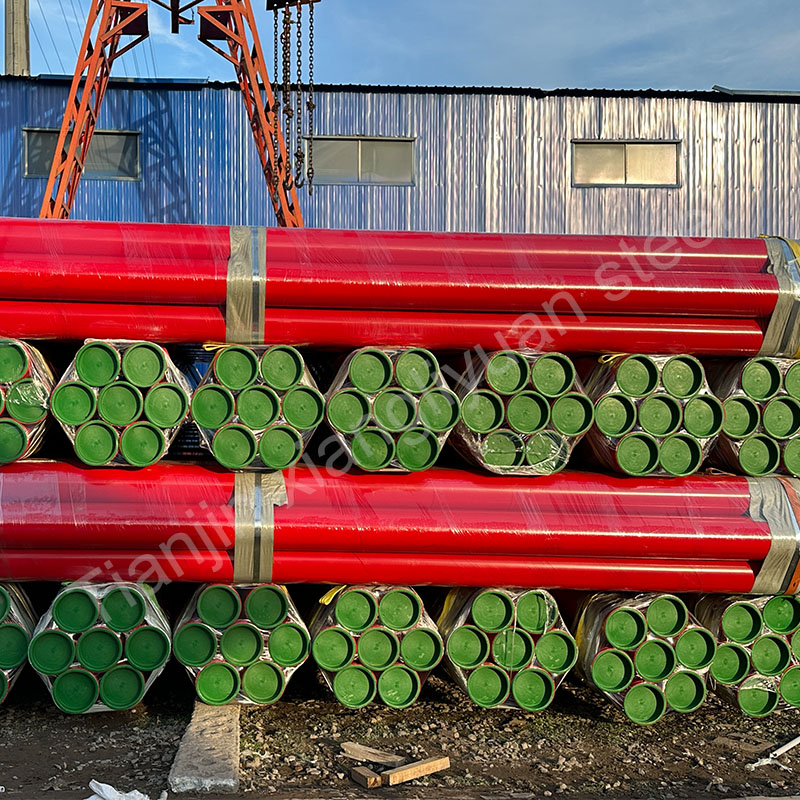
When designing a fire protection system, one of the most critical decisions engineers and contractors face is selecting the appropriate pipe schedule. The choice between Schedule 40 and Schedule 10 steel pipe for wet and dry systems directly impacts system performance, installation costs, and long-term reliability. At Tianjin Xiangliyuan Steel, we have been supplying high-quality fire fighting steel pipe to clients worldwide for years, and we understand the technical nuances that go into making the right selection.
This technical guide provides a comprehensive comparison based on NFPA 13 standards, material properties, and practical installation considerations—helping you make an informed decision for your next fire sprinkler system project.
Understanding Pipe Schedule Designations
The term “schedule” refers to the wall thickness of a pipe for a given nominal pipe size (NPS). Under ASME B36.10M, the outside diameter (OD) remains constant for each NPS regardless of schedule; only the wall thickness and inside diameter (ID) change . This standardization allows for consistent fitting dimensions across different schedules.
Schedule 40 is considered the “standard weight” (STD) pipe and serves as the default specification for most plumbing and fire protection applications. Schedule 10 is classified as a light-wall pipe, offering significant weight and cost savings but with reduced pressure ratings and structural capacity .
The wall thickness gap between these two schedules grows significantly as pipe diameter increases. For example, at NPS 4″, the wall thickness difference is approximately 98% (3.05 mm for Sch 10 versus 6.02 mm for Sch 40). At NPS 8″, the difference reaches 168% (3.76 mm versus 8.18 mm) .
NFPA 13 Requirements for Fire Protection Pipe
NFPA 13 (Standard for the Installation of Sprinkler Systems) governs the use of steel pipe in fire protection systems. Understanding these code requirements is essential for specifying the correct pipe schedule.
The 2022 edition of NFPA 13 permits both Schedule 10 and Schedule 40 steel pipe for fire sprinkler systems, provided they meet the requirements of Table 6.2.3.1 regarding wall thickness and pressure ratings . The key distinction lies in the joining method:
For threaded systems: Schedule 40 is required for pipe sizes smaller than 8″ . The thicker wall provides sufficient material to form reliable NPT (National Pipe Thread) connections as specified in ASME B1.20.1 . For NPS 8″ and larger, Schedule 30 is permitted.
For welded or grooved systems: Schedule 10 is permitted when appropriate non-destructive testing (NDT) is performed and pressure requirements are met . The thinner wall is suitable for roll-grooved or welded joints, which do not require the material thickness that threading demands.
For dry and pre-action systems: Schedule 10 is allowed under NFPA 13, provided the wall thickness and pressure requirements of Table 6.2.3.1 are satisfied . However, contractors and system designers must also verify project specifications, as some contracts—including Department of Defense specifications—still require Schedule 40 for 2″ and smaller pipe .
Wall Thickness and Dimensional Comparison
The table below provides key dimensional data for Schedule 10 and Schedule 40 steel pipe used in fire protection systems :
| NPS | OD (mm) | Sch 10 Wall (mm) | Sch 40 Wall (mm) | Sch 40 vs Sch 10 Thicker By |
|---|---|---|---|---|
| 1″ | 33.4 | 2.77 | 3.38 | ~22% |
| 1¼″ | 42.2 | 2.77 | 3.56 | ~29% |
| 1½″ | 48.3 | 2.77 | 3.68 | ~33% |
| 2″ | 60.3 | 2.77 | 3.91 | ~41% |
| 2½″ | 73.0 | 3.05 | 5.16 | ~69% |
| 3″ | 88.9 | 3.05 | 5.49 | ~80% |
| 4″ | 114.3 | 3.05 | 6.02 | ~98% |
| 6″ | 168.3 | 3.40 | 7.11 | ~157% |
| 8″ | 219.1 | 3.76 | 8.18 | ~168% |
For Schedule 10 pipe, the wall thickness ranges from 2.77 mm for smaller sizes (1″–2″) to 3.76 mm for 8″ pipe. Schedule 40 pipe ranges from 3.38 mm for 1″ to 8.18 mm for 8″. This difference significantly impacts pressure ratings, weight, and material cost .
Pressure Rating Comparison
The pressure capacity of fire fighting steel pipe is one of the most important factors for system design. Schedule 40 pipe generally handles 3 to 7 times higher pressure than Schedule 10, depending on pipe size and material grade .
For ASTM A53 Gr. B carbon steel at ambient temperature, approximate pressure ratings are:
| NPS | Schedule 10 Carbon (psi) | Schedule 40 Carbon (psi) |
|---|---|---|
| 2″ | ~750 | ~1,300 |
| 4″ | ~600 | ~1,500 |
| 6″ | ~500 | ~1,350 |
| 8″ | ~450 | ~1,250 |
For fire protection systems, NFPA 13 permits Schedule 10 only where the working pressure does not exceed 175 psig . This makes Schedule 10 suitable for most commercial and residential sprinkler installations where system pressures are regulated and maintained within this range.
When using ASTM A795 fire sprinkler pipe, the test pressure requirements are typically 4,800–8,300 kPa (approximately 700–1,200 psi) depending on the schedule and size . Both schedules are manufactured to meet these stringent testing requirements.
Weight and Logistics Comparison
Weight is perhaps Schedule 10’s strongest advantage, particularly for international procurement and on-site installation. The weight savings grow exponentially with pipe diameter :
| NPS | Schedule 10 Weight (lb/ft) | Schedule 40 Weight (lb/ft) | Sch 10 Lighter By |
|---|---|---|---|
| 2″ | 2.64 | 3.65 | ~28% |
| 4″ | 5.61 | 10.79 | ~48% |
| 6″ | 9.29 | 18.97 | ~51% |
| 8″ | 13.40 | 28.55 | ~53% |
For a 200-meter run of 8″ pipe, Schedule 10 weighs approximately 3,990 kg compared to 5,710 kg for Schedule 40—a difference of over 30% . This has significant implications:
-
International freight costs: A full truckload of 6″ Schedule 40 pipe carries roughly half the linear footage of Schedule 10. For shipments from China to the Middle East, Europe, or the Americas, this can translate to substantial logistics savings.
-
Installation labor: Crews can handle Schedule 10 lengths with fewer workers and less rigging. For overhead installations, lighter pipe reduces the structural support requirements and installation time .
-
Support structure: Lighter pipe allows for wider hanger spacing and smaller brackets, reducing overall project costs.
At Tianjin Xiangliyuan Steel, located in the port city of Tianjin, we leverage our strategic location to optimize shipping costs and delivery times for our international clients. We are situated close to Tianjin Port, one of China’s busiest and best-connected ports, ensuring efficient logistics for global shipments.
Corrosion Considerations: Wet vs. Dry Systems
Corrosion resistance is a critical factor that influences both schedule selection and material specification for fire protection systems.
Wet pipe systems are filled with water and generally experience lower corrosion rates because dissolved oxygen in the water is consumed over time, limiting further oxidation. However, NFPA 13 requires galvanized pipe for wet systems—black steel pipe is prohibited because it rusts from the inside . Hot-dip galvanized coating per ASTM A123 provides 30–50 years of corrosion protection in normal environments .
Dry pipe and pre-action systems are more susceptible to corrosion because the pipes contain air mixed with moisture. When the system is charged with air (or nitrogen in the case of double-interlock pre-action systems), the presence of oxygen accelerates internal corrosion . Galvanized pipe is recommended, and some engineers specify nitrogen purging to further mitigate corrosion.
Coating thickness requirements for fire protection pipe per ASTM A123 / ISO 1461 are:
| Pipe Wall Thickness | Minimum Average Coating Thickness |
|---|---|
| < 3 mm (Schedule 10) | 55 μm |
| 3–6 mm (Schedule 40) | 70 μm |
UL CRR (Corrosion Resistance Ratio) is another metric used to evaluate pipe corrosion resistance. Schedule 10 pipe typically has a CRR between 1.0 and 7.3, while Schedule 40 pipe has a CRR of 1.0 for threaded schedules—used as the benchmark value .
Applicable Standards and Material Specifications
Fire fighting steel pipe must comply with recognized standards to ensure safety and reliability. The most common specifications for fire protection pipe include:
ASTM A795 – The standard specification for electric-resistance-welded (ERW) steel pipe used in fire sprinkler systems . Types include Type E (ERW) and Type S (seamless). This standard is specifically designed for fire protection applications and is required for UL/FM approvals.
ASTM A135 – Covers electric-resistance-welded steel pipe for fire protection and other applications .
ASTM A53 – The general-purpose steel pipe standard for mechanical and pressure applications. Type E (ERW), Type F (furnace-butt welded), and Type S (seamless) are available for fire protection .
BS 1387 / EN 10255 – British and European standards for steel pipe suitable for fire protection and other applications .
For UL/FM-certified fire protection projects, pipe must meet these standards along with the listing requirements of Underwriters Laboratories (UL) and FM Global—the two most recognized approval bodies in the fire protection industry .
Installation Methods: Threaded vs. Grooved vs. Welded
The selected pipe schedule directly influences the allowable joining method, as established by NFPA 13 :
Threaded joints (Schedule 40): The thicker wall provides adequate material for threading NPT threads per ASME B1.20.1. Schedule 40 is required for any threaded connection, as Schedule 10 lacks sufficient wall thickness for reliable thread engagement. This is particularly important for smaller branch lines (1″–2″) where threaded fittings are commonly specified.
Grooved joints (Schedule 10 or 40): Both schedules can be roll-grooved for mechanical couplings (Victaulic or similar). Schedule 10’s lighter wall is acceptable for grooved systems, and this method is increasingly common in larger mains where the cost and labor savings are significant .
Welded joints (Schedule 10 or 40): Both schedules can be welded with proper procedures. However, Schedule 10 requires more precise parameter control to avoid burn-through due to the thinner wall. Once the correct welding parameters are established, installation proceeds quickly .
Cost Analysis: Total Cost of Ownership
While Schedule 10 typically costs 20–40% less in raw material compared to Schedule 40 for the same NPS and grade, the total cost of ownership must account for multiple factors :
| Cost Factor | Schedule 10 | Schedule 40 |
|---|---|---|
| Raw material | 20–40% lower | Baseline |
| International freight | 25–50% lower | Baseline |
| Support structure/hangers | Lighter brackets, wider spacing | Heavier brackets, closer spacing |
| Installation labor | Faster handling, fewer workers | Heavier, slower placement |
For large-diameter fire protection systems, the total installed cost of a Schedule 10 system can be 30–50% lower than an equivalent Schedule 40 system . These savings are most pronounced in:
-
Commercial and residential fire sprinkler installations with long pipe runs
-
Large-diameter mains where weight savings significantly reduce freight costs
-
Projects where overhead installation requires minimal structural reinforcement
However, Schedule 40 remains the appropriate choice where the application demands:
-
Higher pressure margins or systems subject to pressure spikes and water hammer
-
Threaded connections (required for smaller branch lines)
-
Additional structural strength for heavy loads or seismic zones
-
Projects where future pressure requirements may increase
Why Choose Tianjin Xiangliyuan Steel for Your Fire Protection Pipe?
At Tianjin Xiangliyuan Steel, we offer a comprehensive range of fire fighting steel pipe that meets ASTM A53, ASTM A795, ASTM A135, BS 1387, and EN 10255 standards. Our product portfolio includes:
-
Schedule 10 and Schedule 40 steel pipe in sizes from ½″ to 12″
-
Hot-dip galvanized and black painted surface treatments
-
Threaded, grooved, and plain ends to suit your installation requirements
-
UL/FM-certified options for projects requiring third-party approvals
Our factory location in Tianjin provides a distinct advantage for international clients. As one of China’s most active port cities, Tianjin offers expedited shipping, direct sea routes to the Americas, Europe, the Middle East, and Asia-Pacific, and reduced inland transportation costs. We understand that timely delivery is critical for your fire protection projects, and our logistics team ensures that your orders are shipped promptly and efficiently.
We combine competitive pricing with uncompromised quality. Our manufacturing processes are ISO 9001-certified, and every shipment undergoes rigorous inspection to ensure compliance with your project specifications. Whether you need a container of 4″ Schedule 10 galvanized pipe for a residential project or a bulk order of 8″ Schedule 40 black steel for a large commercial installation, we deliver consistency and reliability.
Contact our technical sales team today to discuss your fire fighting steel pipe requirements:
Tianjin Xiangliyuan Steel
📧 infosteel@xlygt.com
🌐 https://www.xlysteel.com/
We look forward to partnering with you on your next fire protection project.