H-beams and I-beams (usually referring to I-beams) are the most commonly used steel profiles in modern steel structures. While they look similar, there are important differences. The following is a detailed introduction to their common specifications, dimensions, and materials.
I. Main differences between H-beams and I-beams
| characteristic | H-Beam | I-Beam |
|---|---|---|
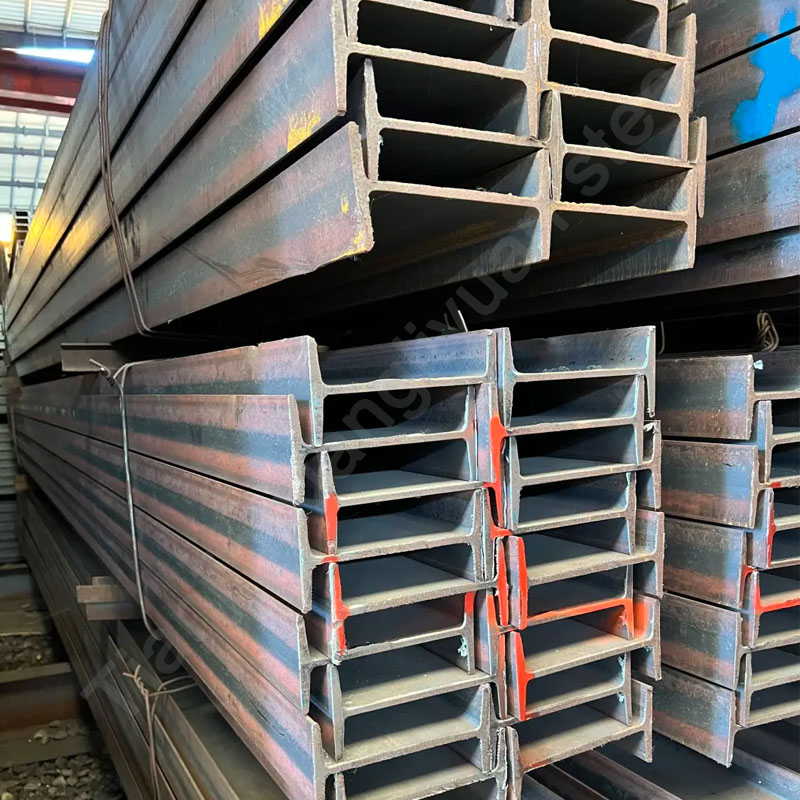
| Wing edge (leg) | The inner and outer sides are parallel, and the wing edges are wide and thick | The inner side has a slope (usually 1:6 to 1:10), and the flange is relatively narrow. |
| Cross-sectional mechanical properties | Optimized cross-section, high load-bearing capacity, and more economical | The cross-section is concentrated in the middle of the web, resulting in relatively weak bending resistance |
| Production Standards | GB/T 11263 | GB/T 706 |
| Specifications | It is usually expressed as height (H) × width (B) × web thickness (t1) × flange thickness (t2) | It is usually expressed as height (h) × leg width (b) × waist thickness (d) |
| application | Mainly used for load-bearing structural columns and beams (especially heavy columns) | More commonly used in beams or lightweight structures |
Simple way to remember: The “H” in H-beams looks like two parallel lines, with flanges of equal thickness; the “I” in I-beams has a slope on the inside.
II. Common Specifications and Dimensions
1. H-beams
Chinese standards mainly classify them into three categories: wide-flange HW, medium-flange HM, and narrow-flange HN. There is also HP for piles (equal flange thickness).
Representation method: Height H (mm) × Width B (mm) × Web thickness t1 (mm) × Flange thickness t2 (mm)
For example: H350×350×12×19 indicates a wide-flange H-beam with a height and width of 350mm, a web thickness of 12mm, and a flange thickness of 19mm.
Common specification range (excerpted from GB/T 11263-2017):
Wide-flange HW:
Mainly used for steel columns, with similar width and height in the cross-section, and good compressive strength.
Example Specifications: 100×100 ~ 400×400
Common Specifications: HW150×150, HW200×200, HW250×250, HW300×300, HW350×350, HW400×400
Middle Flange (HM):
Suitable for columns and beams.
Example Specifications: 150×100 ~ 600×300
Common Specifications: HM200×150, HM300×200, HM400×300, HM500×300, HM600×300
Narrow Flange (HN):
Primarily used for steel beams, with a large aspect ratio and excellent bending resistance.
Example Specifications: 100×50 ~ 1100×400
Common Specifications: HN200×100, HN300×150, HN400×200, HN500×200, HN588×300, HN700×300, HN800×300, HN900×300, HN1000×300
Thin-Web H-Beams:
Lighter in weight, used for lightweight structures.
Similar specifications, but thinner.
2. I-Beams (I-shaped Beams)
Representation: Model number (corresponding height in centimeters) or Height (h) × Flange width (b) × Web thickness (d)
For example: I10 or 100×68×4.5 indicates an I-beam with a height of 100mm.
Common specifications (excerpt from GB/T 706-2016):
Classified by model: 10#, 12#, 14#, 16#, 18#, 20#, 22#, 25#, 28#, 32#, 36#, 40#, 45#, 56#, 63#, etc.
For example:
10# I-beam: 100×68×4.5
20# I-beam: 200×100×7.0
36# I-beam: 360×136×10.0
63# I-beam: 630×176×13.0
III. Common Materials
The material of H/I Beam mainly depends on its application and mechanical performance requirements. The most commonly used are carbon structural steel and low-alloy high-strength structural steel.
Q235 Series (Most Commonly Used)
Q235B: The most widely used material. It has good plasticity, toughness, and weldability. Suitable for general building structures, bridges, supports, etc. Grade B indicates that room temperature (20℃) impact toughness must be guaranteed.
Q235A: Guarantees mechanical properties, but the impact toughness requirement is lower than Grade B. It is now less commonly used in main load-bearing structures.
Q235C, Q235D: Guaranteed impact toughness at 0℃ or -20℃, used in low-temperature environments.
Q355 Series (formerly Q345, recommended)
Q355B: Low-alloy high-strength steel, its usage is increasing. Its strength is significantly higher than Q235 (yield strength 355MPa), allowing for weight reduction under the same load-bearing capacity, making it more economical. Grade B guarantees room temperature impact toughness.
Q355C, Q355D, Q355E: Guaranteed low-temperature impact toughness at 0℃, -20℃, and -40℃ respectively, used in important structures such as bridges, ships, power plants, and cryogenic pressure vessels.
Q390, Q420, Q460, and other higher-strength steels:
Used for large or heavy structures bearing greater loads and requiring reduced weight, such as high-rise buildings, long-span stadiums, and bridges. Higher price and more stringent welding and other process requirements.
Other special materials:
Weathering steel: Such as Q355NH, containing alloying elements such as copper, phosphorus, and chromium, with strong resistance to atmospheric corrosion, used in exposed structures, bridges, and containers.
Fire-resistant steel: Maintains high strength at high temperatures, used in special buildings with fire protection requirements.
IV. Selection and Application Points
Clarify the application: Wide-flange HW steel is preferred for columns; narrow-flange HN steel is preferred for main beams; I-beams or thin-walled H-beams can be used for secondary beams or lightweight structures.
Verification Standards: When purchasing, be sure to specify whether GB/T 11263 (H-beams) or GB/T 706 (I-beams) is being followed, and provide complete specifications.
Specified Material: Clearly specify the material grade (e.g., Q235B or Q355B) and grade requirements (especially when low-temperature impact toughness is required).
Reference to National Standards and Design Drawings: Specific engineering specifications should be based on the drawings and material list provided by the structural designer.
Hopefully, this detailed summary will help you fully understand the specifications and materials of H/I-section steel. In practical applications, please be sure to select according to specific design requirements. Feel free to contact Tianjin Xiangliyuan Steel for a quote; our engineers will provide you with a comprehensive H/I-section steel solution – infosteel@xlygt.com.