In our previous guide, we explored the fundamental world of carbon steel pipes. While standards like ASTM A53 and A106 form the bedrock of countless projects, many industrial challenges demand more specialized solutions. The right pipe is not just about material; it’s about precise engineering for specific environments—be it corrosive conditions, extreme structural loads, or the need for superior surface quality.
At Tianjin Xiangliyuan Steel, our manufacturing expertise extends far beyond standard offerings. We specialize in producing a range of advanced carbon steel pipes designed to meet the rigorous demands of modern engineering. This article delves into these specialized products, helping you identify the perfect solution for your most challenging applications.
1. Galvanized Steel Pipes: The Champion of Corrosion Resistance
One of the most common and effective enhancements to carbon steel pipe is the galvanization process.
What is it? A galvanized steel pipe is a standard carbon steel pipe that has been coated with a protective layer of zinc. This is primarily achieved through Hot-Dipped Galvanizing (HDG), where the pipe is immersed in a bath of molten zinc, creating a metallurgical bond that is both tough and durable.
Key Advantages:
Superior Corrosion Resistance: The zinc layer acts as a physical barrier against moisture and corrosive elements. It also provides cathodic protection; if the coating is scratched, the zinc sacrificially corrodes before the underlying steel.
Long Service Life: Galvanized pipes can last for decades, even in harsh outdoor or semi-exposed environments, significantly reducing maintenance and replacement costs.
Cost-Effective Protection: Galvanizing offers excellent long-term value, providing robust corrosion protection at a fraction of the cost of stainless steel for many applications.
Common Applications:
Water Supply and Plumbing Systems: For both potable water and fire sprinkler systems.
Fencing, Handrails, and Structural Frameworks outdoors.
Construction Scaffolding exposed to the elements.
Agricultural Equipment and irrigation systems.
2. Structural Steel Tubes: The Backbone of Modern Architecture
When the primary function is to bear load and provide structural integrity, carbon steel structural tubing is the product of choice.
What is it? These are pipes manufactured to specific dimensional and mechanical strength standards, such as ASTM A500, which defines carbon steel structural tubing. They are characterized by their high strength-to-weight ratio and are available in various shapes: Round, Square, and Rectangular.
Key Advantages:
High Strength and Stability: Formulated and processed to withstand heavy compressive and tensile loads, making them ideal for columns, beams, and trusses.
Aesthetic and Functional Design: Square and rectangular tubes offer a clean, modern look for architectural applications and are easier to fabricate and join than wide-flange beams in certain designs.
Excellent Weldability and Machinability: Allows for easy integration into complex structural frameworks.
Common Applications:
Building and Bridge Construction: As primary support columns and beams.
Industrial Mezzanines and Racking Systems.
Vehicle Chassis and Roll Cages in automotive and transportation industries.
Agricultural and Heavy Machinery frames.
3. Alloy Steel Pipes: Engineered for Extreme Conditions
For applications where standard carbon steel reaches its limits, alloy steel pipes provide the necessary performance.
What is it? These pipes are made from steel that contains deliberate additions of alloying elements like Chromium (Cr), Molybdenum (Mo), Nickel (Ni), and others. These additions significantly enhance specific mechanical properties. A common and critical standard is ASTM A335, which covers seamless alloy-steel pipe for high-temperature service.
Key Advantages:
Enhanced Strength and Hardness: Alloying creates a finer grain structure, resulting in superior tensile and yield strength.
Improved Toughness and Impact Resistance: Performs well in low-temperature environments where standard carbon steel can become brittle.
Superior High-Temperature Performance: Grades like P5, P9, P11, P22, and P91 retain their strength and resist creep (deformation under constant stress) at elevated temperatures.
Better Corrosion and Wear Resistance: Certain alloy combinations improve resistance to oxidation and abrasion.
Common Applications:
Power Generation Boilers and Superheaters: Where steam temperatures and pressures are extremely high.
Petrochemical and Refinery Piping: Transporting corrosive hydrocarbons at high temperatures.
Heat Exchanger and Condenser Tubes.
High-Pressure Hydraulic Lines and high-stress mechanical components.
4. DOM (Drawn Over Mandrel) Steel Tubing: The Pinnacle of Precision
When your application requires unparalleled dimensional accuracy and a superior surface finish, DOM steel tubing is the answer.
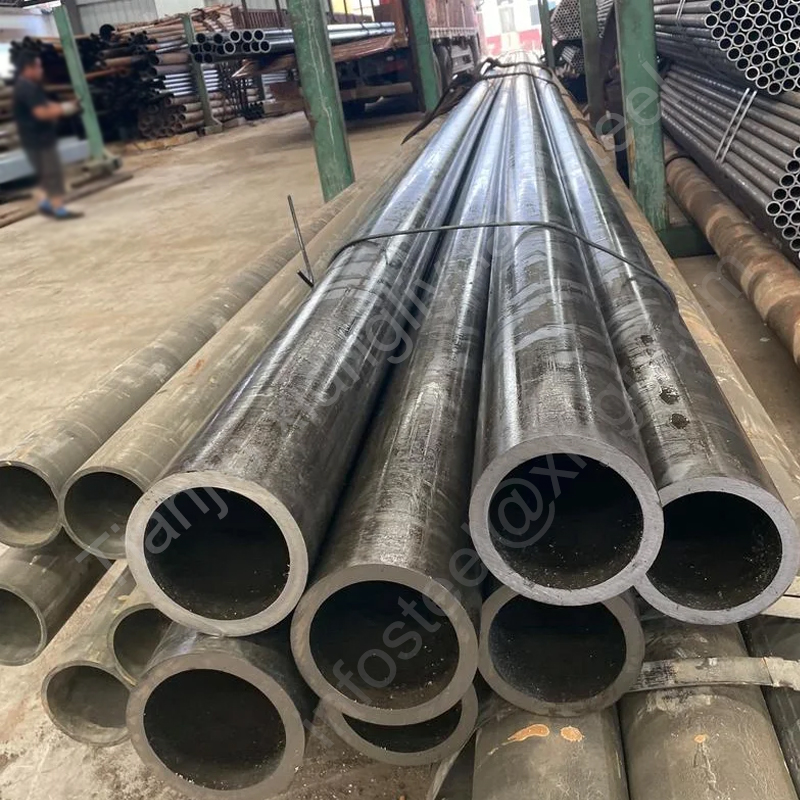
What is it? DOM (Drawn Over Mandrel) tubing starts as a ERW (Electric Resistance Welded) pipe. It is then cold-drawn through a die and over a mandrel. This process transforms the pipe, creating a product with properties closer to seamless pipe but with exceptional consistency.
Key Advantages:
Exceptional Dimensional Tolerances: Very consistent and precise inside diameter (ID) and outside diameter (OD) with uniform wall thickness.
Superior Surface Finish: Both the inner and outer surfaces are smooth and free of scale.
Enhanced Strength and Ductility: The cold-drawing process increases yield strength and creates a more uniform grain structure.
Excellent Weldability and Machinability: The consistent chemistry and structure make it ideal for precision fabrication.
Common Applications:
Hydraulic and Pneumatic Cylinders.
Shafting and Precision Mechanical Components.
Automotive and Off-Road Vehicle Parts (e.g., shock absorbers, driveshafts).
Bearings and Bushings.
5. Choosing the Right Specialized Pipe: A Quick Guide
Need corrosion resistance for outdoor or water use? -> Choose Galvanized Steel Pipe.
Building a framework, support structure, or chassis? -> Choose Carbon Steel Structural Tubing (A500).
Operating in high-temperature, high-pressure, or corrosive process environments? -> Choose Alloy Steel Pipe (A335).
Requiring ultra-precise dimensions and a smooth finish for mechanical parts? -> Choose DOM Steel Tubing.
Why Partner with Tianjin Xiangliayan Steel for Your Specialized Needs?
Manufacturing these advanced pipes requires sophisticated technology, deep metallurgical knowledge, and an unwavering commitment to quality—all hallmarks of our operation.
Advanced Production Lines: We operate continuous galvanizing lines, cold-drawing mills for DOM tubing, and precision forming mills for structural tubing, ensuring we meet the tightest tolerances.
Material Expertise: Our technical team possesses deep knowledge of alloy compositions and heat-treatment processes to deliver pipes that meet exact mechanical property requirements.
Rigorous Testing Protocol: Every batch of specialized pipe undergoes relevant testing, including hydrostatic tests, flattening tests, flaring tests, hardness tests, and chemical analysis, all documented with Mill Test Certificates.
Global Supply Capability: We understand the urgency of international projects. Our strategic location and logistics partnerships ensure timely delivery of both standard and custom-sized products to your port or project site.
Elevate Your Project with Precision-Engineered Solutions
The world of carbon steel pipes is vast and nuanced. By understanding the unique properties of galvanized, structural, alloy, and DOM pipes, you can make informed decisions that optimize performance, longevity, and total project cost.
Don’t let a standard solution limit your project’s potential. Let Tianjin Xiangliyuan Steel provide you with the specialized pipe that your application truly demands.
Contact us today to discuss your technical requirements and request a competitive quotation for any of our high-performance carbon steel pipes. Our experts are ready to assist you.