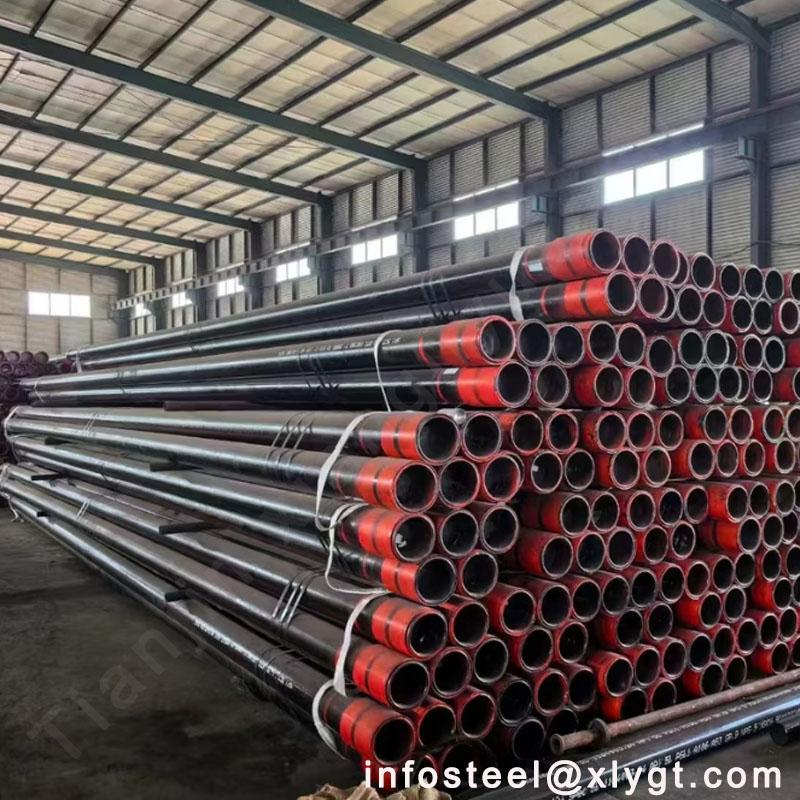
The selection of appropriate API 5CT casing and tubing steel grades represents one of the most critical engineering decisions in oil and gas well construction. As a leading OCTG (Oil Country Tubular Goods) supplier based in Tianjin, China, Tianjin Xiangliyuan Steel understands that matching the right steel grade to specific downhole conditions directly impacts well integrity, operational safety, and project economics. This comprehensive technical guide examines the performance characteristics, mechanical properties, and application scenarios for API 5CT grades from J55 through Q125, providing petroleum engineers and procurement professionals with data-driven insights for optimal material selection.
For technical consultations or quotation requests, contact our engineering team at infosteel@xlygt.com or visit our comprehensive product catalog at https://www.xlysteel.com/.
Understanding API 5CT Standard and Grade Classification
The API Specification 5CT, developed by the American Petroleum Institute, establishes the technical delivery conditions for seamless and welded steel pipes used in oil and gas well construction. This standard defines critical parameters including chemical composition, mechanical properties, manufacturing processes, testing protocols, and dimensional tolerances for casing pipe and tubing applications .
API 5CT organizes steel grades into four distinct groups based on mechanical properties and intended service environments:
Group 1: Grades H40, J55, K55, N80, R95
Group 2: Grades C90, T95, L80 (including L80-1, L80-9Cr, L80-13Cr)
Group 3: Grade P110
Group 4: Grade Q125
Each group represents progressively higher yield strength capabilities and specialized performance characteristics designed to address specific downhole challenges .
Group 1 Analysis: Standard Strength Grades
API 5CT J55: The Economical Foundation
API 5CT J55 represents the most widely utilized entry-level grade in the OCTG market. With minimum yield strength of 379 MPa (55 ksi) and maximum yield strength of 552 MPa, J55 provides adequate mechanical performance for shallow well applications where pressure containment requirements remain modest .
Mechanical Properties:
Yield Strength: 379–552 MPa
Tensile Strength: Minimum 517 MPa
Elongation: Minimum 19%
Hardness: Not specified (controlled through chemistry)
Chemical Composition (Max %):
Carbon: 0.26%
Manganese: 0.30–1.35%
Phosphorus: 0.030%
Sulfur: 0.030%
J55 exhibits excellent weldability and formability, making it ideal for surface casing and conductor pipe applications. However, its limited corrosion resistance and moderate strength render it unsuitable for sour service environments containing hydrogen sulfide (H₂S) or deep well applications experiencing high axial loads.
API 5CT K55: Enhanced Tensile Performance
API 5CT K55 shares identical yield strength parameters with J55 (379–552 MPa) but offers significantly enhanced tensile strength with a minimum requirement of 655 MPa compared to J55’s 517 MPa . This elevated tensile performance provides improved resistance to deformation under combined loading conditions.
K55 is frequently specified for intermediate casing strings in onshore development wells where moderate pressure containment is required. The grade maintains cost-effectiveness while delivering superior mechanical reliability compared to J55, particularly in wells experiencing bending stresses during installation.
API 5CT N80: Intermediate Strength Solution
API 5CT N80 bridges the gap between standard and high-performance grades, offering minimum yield strength of 552 MPa and maximum yield strength of 758 MPa . Available in two variants—N80-1 (normalized) and N80Q (quenched and tempered)—this grade accommodates different manufacturing preferences while maintaining consistent mechanical performance.
Key Specifications:
Yield Strength: 552–758 MPa
Tensile Strength: Minimum 689 MPa
Elongation: Minimum 15%
Charpy Impact Requirements: Mandatory for N80-1
N80 demonstrates enhanced toughness characteristics compared to J55/K55, making it suitable for deeper well applications up to approximately 20,000 feet. The quenched and tempered N80Q variant exhibits superior through-wall hardness uniformity, providing consistent performance in demanding downhole environments.
Group 2 Analysis: Sour Service and High-Performance Grades
API 5CT L80: The Corrosion Resistance Standard
API 5CT L80 represents a critical evolution in OCTG metallurgy, specifically engineered for sour service environments containing hydrogen sulfide. With yield strength controlled between 552–655 MPa and maximum hardness restricted to 23 HRC (Rockwell C), L80 prevents sulfide stress cracking (SSC) while maintaining adequate load-bearing capacity .
L80 Sub-Grades:
L80-1: The standard carbon steel variant produced through quenching and tempering, suitable for mild sour service conditions with controlled H₂S partial pressures.
L80-9Cr: Incorporating 9% chromium content, this variant provides enhanced resistance to CO₂ corrosion and moderate H₂S environments. The Cr-Mo alloy system ensures through-wall hardenability and tempering stability .
L80-13Cr: With 13% chromium content, this premium variant delivers exceptional corrosion resistance in aggressive environments containing both CO₂ and H₂S. The fully tempered martensitic microstructure achieves 85% SMYS (Specified Minimum Yield Strength) performance in NACE TM0177 test conditions .
API 5CT C90 and T95: Controlled Yield Applications
API 5CT C90 and API 5CT T95 provide intermediate high-strength options with controlled hardness limits (maximum 25.4 HRC) specifically designed for sour service applications requiring higher strength than L80 .
C90 Specifications:
Yield Strength: 621–724 MPa
Tensile Strength: Minimum 689 MPa
T95 Specifications:
Yield Strength: 655–758 MPa
Tensile Strength: Minimum 724 MPa
These grades utilize sophisticated alloy designs with controlled carbon equivalents to maintain weldability while achieving superior strength-to-hardness ratios. They are frequently specified for HPHT (High Pressure High Temperature) wells where conventional grades prove inadequate.
Group 3 Analysis: High-Strength Performance
API 5CT P110: Deep Well Reliability
API 5CT P110 represents the industry standard for high-strength casing applications, delivering minimum yield strength of 758 MPa (110 ksi) and maximum yield strength of 965 MPa . This grade enables significant wall thickness reductions compared to lower grades, optimizing casing program economics while maintaining structural integrity.
Mechanical Properties:
Yield Strength: 758–965 MPa
Tensile Strength: Minimum 862 MPa
Elongation: Minimum 10%
P110 is extensively utilized in deep drilling operations, offshore developments, and high-pressure reservoirs where collapse resistance and internal pressure containment are critical. The grade’s exceptional ductility ensures reliable performance under extreme axial loads and bending stresses encountered in directional drilling applications.
At Tianjin Xiangliyuan Steel, our P110 casing pipe inventory includes standard API connections (STC, LTC, BTC) and premium threaded options, with comprehensive third-party inspection capabilities including EMI, SEA, and ultrasonic testing.
Group 4 Analysis: Ultra-High Strength
API 5CT Q125: Extreme Environment Capability
API 5CT Q125 stands as the highest standardized grade within API 5CT, engineered for the most demanding downhole conditions including ultra-deep wells and extreme HPHT environments .
Mechanical Properties:
Yield Strength: 862–1034 MPa
Tensile Strength: Minimum 931 MPa (maximum 1207 MPa)
Elongation: Minimum 10%
The Q125 chemistry permits higher carbon content (maximum 0.50%) and increased chromium (maximum 1.5%) and molybdenum (maximum 0.50%) additions compared to lower grades, enabling the formation of high-strength martensitic microstructures through sophisticated heat treatment protocols .
Q125 is exclusively specified for casing applications (not tubing) due to its limited wall thickness availability and specialized connection requirements. Typical applications include ultra-deepwater wells, high-pressure gas condensate reservoirs, and geothermal developments where conventional grades cannot withstand operational stresses.
Selection Methodology: Matching Grade to Application
Well Depth and Pressure Considerations
Shallow Wells (0–5,000 ft): J55 and K55 provide cost-effective solutions for surface and conductor casing with minimal corrosion concerns.
Intermediate Depth (5,000–15,000 ft): N80 and L80 accommodate higher formation pressures while providing enhanced toughness for deeper installations.
Deep Wells (15,000–25,000 ft): P110 delivers optimal strength-to-weight ratios, reducing hook loads and casing program costs.
Ultra-Deep Wells (>25,000 ft): Q125 provides necessary collapse resistance and pressure containment for extreme environments.
Corrosion Environment Assessment
Sweet Service (No H₂S): All grades applicable; selection based on strength requirements.
Mild Sour Service: L80-1 with appropriate coating systems.
Moderate Sour Service: L80-9Cr, L80-13Cr, C90, or T95 depending on H₂S partial pressure and temperature.
Severe Sour Service: Specialized 13Cr alloys or duplex stainless steels beyond standard API 5CT grades.
Connection Selection Strategy
API Round Thread (STC/LTC): Economical options for low-pressure, non-critical applications with J55, K55, and N80 grades.
Buttress Thread (BTC): Enhanced torque capacity and sealing performance for medium-pressure applications.
Premium Connections: Gas-tight metal-to-metal seals essential for HPHT wells utilizing P110 and Q125 grades.
Tianjin Xiangliyuan Steel: Your OCTG Supply Partner
Located in Tianjin, China’s premier steel production and port logistics hub, Tianjin Xiangliyuan Steel offers unparalleled supply chain advantages for global OCTG procurement. Our strategic proximity to Tianjin Port—one of the world’s busiest container terminals—enables efficient export logistics and competitive freight rates to destinations worldwide.
Technical Capabilities and Quality Assurance
Our API 5CT casing and tubing manufacturing and supply operations encompass:
Full Grade Coverage: J55, K55, N80-1, N80Q, L80-1, L80-9Cr, L80-13Cr, C90, T95, P110, and Q125
Dimensional Range: Casing 4-1/2″ to 20″ OD; Tubing 1.05″ to 4-1/2″ OD
Length Options: R1 (4.88–7.62m), R2 (7.62–10.36m), R3 (10.36–14.63m)
Thread Types: STC, LTC, BTC, NU, EU, IJ, and premium connections
Testing Protocols: Hydrostatic testing, NDT (ultrasonic and electromagnetic inspection), drift testing, and full-length hardness verification
Value-Added Services
Technical Consultation: Application engineering support for grade selection and casing design optimization
Third-Party Inspection: SGS, BV, or customer-specified inspection agencies
Custom Processing: Cutting, threading, coupling installation, and coating applications
Documentation: Mill Test Reports (MTR), API Monogram certificates, and complete traceability records
The API 5CT steel grade spectrum—from foundational J55 through ultra-high-strength Q125—provides petroleum engineers with a comprehensive toolkit for addressing diverse downhole challenges. Successful grade selection requires systematic evaluation of well depth, pressure/temperature conditions, corrosion environment, and economic constraints.
Tianjin Xiangliyuan Steel combines extensive inventory availability, technical expertise, and logistical advantages to support your OCTG procurement requirements. Whether your project demands standard J55 surface casing or specialized Q125 ultra-deep strings, our engineering team stands ready to provide material recommendations and competitive quotations.
Contact us today at infosteel@xlygt.com or explore our complete product specifications at https://www.xlysteel.com/. Let our experience in seamless steel pipe manufacturing and global supply chain management contribute to your project’s success.
This technical article is provided for engineering reference purposes. Specific grade selection should always consider detailed well design parameters and applicable regulatory requirements. For project-specific recommendations, consult with qualified petroleum engineering professionals.