The Critical Role of Straightness in Pipeline Performance
In the global transmission of oil, natural gas, and high-pressure fluids, even minor deviations in steel pipe straightness can lead to catastrophic consequences. Excessive bending causes uneven stress distribution during welding, accelerates fatigue cracking, and prevents proper alignment of flange connections or subsea pipeline laying. For seamless steel pipe, ERW steel pipe, LSAW steel pipe, and line pipe used in critical infrastructure, straightness is not merely an aesthetic quality—it is a fundamental mechanical property that directly impacts installation efficiency and long-term operational safety.
Industry specifications mandate specific straightness tolerances because pipelines often span thousands of kilometers. A 6-meter pipe section with a 2mm bow may appear negligible, but when multiplied across 10,000 joints, the cumulative deviation becomes impossible to correct without costly field modifications.
At Tianjin Xiangliyuan Steel, we understand that every millimeter of deviation per meter length translates to hours of costly field adjustment. As a premier supplier strategically located near Tianjin Port, we combine advanced straightening technology with rigorous tolerance standards to deliver pipe that meets or exceeds API 5L, ASTM A53, ASTM A106, and EN 10217-7 requirements.
This article provides an authoritative, technical deep-dive into steel pipe straightness control, covering straightening machinery, process parameters, measurement methodologies, and global tolerance standards. Whether you are procuring carbon steel pipe for a cross-country gas line or alloy steel pipe for a refinery, understanding these principles ensures you specify the right product for your application.
Understanding Pipe Straightness – Definitions and Measurement Units
Before discussing correction technology, we must define how straightness is quantified. Industry standards use three primary measurement units:
1.1 Total Bowing (mm per total length)
The maximum deviation of the pipe’s central axis from a straight reference line over the full pipe length. Example: “Total bowing ≤ 3 mm over 12,000 mm length.”
1.2 Chord Measurement (mm per meter)
The most common method. The pipe is rotated on supports, and a feeler gauge measures the gap between the pipe surface and a straightedge placed along the pipe’s generatrix. API 5L requires that for pipe with D/t ratio > 30, the deviation shall not exceed 0.2% of the total length.
1.3 End Straightness (Squareness of cut ends)
A separate but related parameter. Pipe ends must be perpendicular to the pipe axis within a defined tolerance (typically ≤ 1 mm per 100 mm of diameter).
Formula for Chord Method Calculation:
Straightness deviation (mm/m) = (Maximum gap under straightedge) / (Length of straightedge) × 1000
For example, if a 1,000 mm straightedge reveals a 0.5 mm gap at the midpoint, the straightness is 0.5 mm/m.
Why Pipes Become Bent – Root Causes in Manufacturing
Effective straightening requires understanding the sources of curvature. At Tianjin Xiangliyuan Steel, we categorize bending origins into four stages:
2.1 Heat Treatment Distortion
During normalizing, quenching and tempering (Q&T) , or annealing, uneven heating and cooling rates generate internal residual stresses. Seamless pipes are especially vulnerable because wall thickness variations (eccentricity) cause differential thermal contraction.
2.2 Uneven Cooling After Hot Rolling
For seamless steel pipe produced on a mandrel mill, the pipe exits the sizing mill at 800-1,000°C. Uneven cooling on the cooling bed can induce curvature of 10-15 mm/m if not immediately straightened.
2.3 Forming Stresses in Welded Pipe
ERW steel pipe and LSAW steel pipe develop residual stresses at the weld seam due to localized heating and rapid cooling. The weld seam shrinks differently from the base metal, creating a “camber” or bow toward the weld. Sizing rolls help correct initial ovality, but straightening specifically addresses linearity.
2.4 Handling and Transportation
Improper stacking or lifting during loading can permanently bend long-length line pipe. This is why our location near Tianjin Port allows us to load directly from our straightening line to shipping vessel, minimizing handling-induced deformation.
Straightening Technology – Machinery and Process Parameters
Modern pipe straightening relies on two principal machine types, each suited to specific product dimensions and precision requirements.
3.1 Two-Roll Straightening (Precision Straightening)
Best for small-diameter seamless pipe (≤ 168 mm OD) and precision tube applications. The pipe passes between two skewed rolls that apply opposing bending forces, plastically deforming the pipe to eliminate curvature.
Key Process Parameters:
-
Roll angle (skew angle): 25° to 35° – Controls axial feed rate
-
Roll gap: Set to 0.8-1.0 × pipe OD
-
Number of passes: Typically 2-3 passes for high-grade API 5L X65
Advantages: High precision (±0.2 mm/m), excellent surface finish preservation.
3.2 Six-Roll or Seven-Roll Straightening (Heavy-Duty)
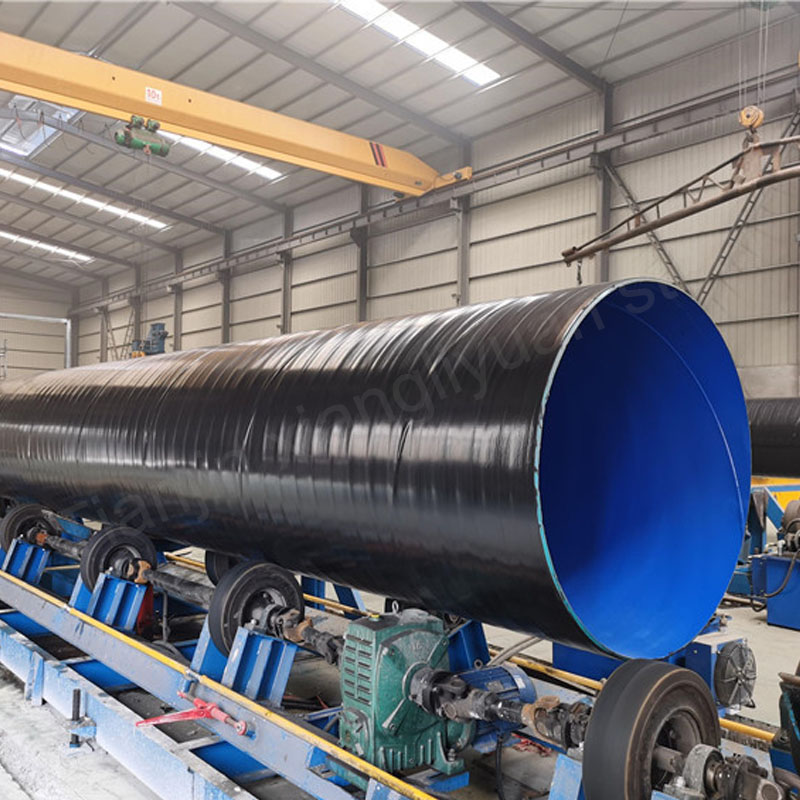
Used for LSAW pipe, large-diameter seamless pipe (≥ 219 mm OD), and heavy-wall pipe (t > 25 mm). These machines have three pairs of rolls arranged in a staggered configuration, progressively reducing bending amplitude.
The principle behind multi-roll straightening is controlled reverse-bending—applying calculated plastic deformation at multiple points to eliminate previous warping tendencies. Each successive roll pair applies bending in the opposite direction, gradually reducing residual curvature until the pipe achieves linearity.
Our Capability at Tianjin Xiangliyuan Steel: We operate a seven-roll straightening line capable of processing pipe up to 1,220 mm OD and 25-meter length. This machine integrates automatic roll positioning based on pipe diameter and wall thickness, reducing setup time and ensuring repeatability.
3.3 Rotary Straightening vs. Press Straightening
| Method | Application | Tolerance Achievable | Cycle Time |
|---|---|---|---|
| Rotary (Roll) Straightening | Continuous processing of long pipe | ±0.5 mm/m | 1-2 m/sec feed rate |
| Press (Ram) Straightening | Spot correction of localized bends | ±0.2 mm/m at bend point | 30-60 seconds per bend |
At Tianjin Xiangliyuan Steel, we use rotary straightening as primary process, followed by laser-guided press straightening for any residual localized deviations detected during our automated ultrasonic testing (AUT) inspection.
3.4 Advanced Technologies: Stabilizing and Straightening Integration
Recent innovations in straightening technology include integrated stabilizing systems. Patent developments have introduced mechanisms that stabilize the unstraightened section of pipe during processing, preventing swing or vibration during the straightening operation. These systems use triangular-distribution pressure rollers to secure the pipe, significantly improving straightening consistency for long-length products.
Global Tolerance Standards – API 5L, ASTM, and Beyond
Compliance with internationally recognized pipe specifications is mandatory for export. Below is our interpretation of the most critical straightness clauses.
4.1 API 5L (45th Edition) – Clause 9.14
For line pipe used in oil and gas transmission:
-
Total straightness deviation ≤ 0.2% of total pipe length
-
Example: A 12,000 mm pipe shall not deviate more than 24 mm over its entire length
-
Local straightness (any 1,000 mm segment) ≤ 2 mm
PSL2 Requirement: Additional verification using a straightedge and feeler gauge at 90° rotational intervals. Pipe failing at any rotation is rejected.
4.2 ASTM A53 / A106 (Seamless Carbon Steel Pipe)
-
Maximum deviation: 0.125 inch per 5 feet (approximately 2.08 mm/m)
-
More lenient than API 5L, but project specifications often invoke API 5L tolerances for high-pressure service
4.3 EN 10217-7 (Welded Steel Tubes for Pressure Purposes)
-
Straightness tolerance: ≤ 0.15% of total length for tubes with D/t < 50
-
For D/t > 50, tolerance: ≤ 0.2% of total length
4.4 Precision Applications (Cold Drawn Tubes)
For precision cold-drawn seamless tubes used in hydraulic cylinders, automotive drive shafts, and mechanical components, straightness requirements are significantly tighter. High-precision applications demand straightness of 0.5 mm per 1000 mm (0.5/1000mm) or better, achieved through multiple cold drawing passes and specialized straightening processes.
4.5 Project-Specific Tolerances (EPC Contracts)
Major EPC contractors (e.g., Saipem, McDermott, Technip) frequently impose tighter tolerances:
-
Subsea pipeline: ≤ 1 mm per 3 meters (0.33 mm/m) to ensure J-lay or S-lay welding alignment
-
Casing pipe for oil wells: ≤ 0.5 mm per meter to prevent wear on rotating drill strings
Our Commitment: We routinely supply API 5L X52, X60, and X70 with enhanced straightness of ≤ 1 mm/m upon request. Contact our engineering team at infosteel@xlygt.com to discuss custom tolerances.
4.6 Comparison of International Tolerance Standards
| Standard | Outer Diameter Tolerance | Wall Thickness Tolerance | Straightness Requirement |
|---|---|---|---|
| API 5L | ±0.75% | ±12.5% | ≤ 0.2% of total length |
| ASTM A106 | ±1% | ±12.5% | ≤ 2.08 mm/m |
| ASTM A53 | ±1% | ±12.5% | ≤ 2.08 mm/m |
| EN 10216-1 | ±1% | ±12.5% | ≤ 0.15%-0.2% of length |
| GB/T 3091 | ±1% or ±0.5mm | ±10% | ≤ 1.5 mm/m |
Data compiled from industry standards
Measurement and Quality Assurance Protocols
Straightness claims are meaningless without verifiable measurement. At Tianjin Xiangliyuan Steel, we employ three independent measurement methods:
5.1 Laser Alignment System (Primary)
A rotating laser transmitter projects a reference beam along the pipe axis. Sixteen photodetectors measure radial deviation at 500 mm intervals. Data is recorded to a mill test certificate (MTR) with ±0.05 mm accuracy. This method is particularly valuable for long-length pipes where manual measurement becomes impractical.
5.2 Straightedge and Feeler Gauge (Verification)
Manual verification per API 5L Annex G. A 1,000 mm precision ground straightedge (calibrated to grade 00) is placed along four longitudinal lines offset by 90°. The maximum gap under the straightedge determines local straightness. This remains the industry-accepted reference method for dispute resolution.
5.3 Chord Method for Long Pipe (Shop Floor)
For pipe lengths exceeding 15 meters, we use a stretched piano wire (0.3 mm diameter, 50 kg tension) as a reference line. Deviation is measured at midpoint using a micrometer microscope.
Documentation: Every shipment includes a dimensional report listing:
-
Maximum total bowing (mm)
-
Maximum local straightness per meter (mm/m)
-
End squareness (mm per 100 mm diameter)
-
Equipment calibration dates (traceable to national standards)
-
Straightening process parameters recorded in our MES system
Case Study – Straightening High-Grade X70 LSAW Pipe for Subsea Project
Challenge: A Korean EPC contractor required 18,000 meters of LSAW steel pipe (762 mm OD x 22.2 mm wall, API 5L X70 PSL2) with maximum local straightness of 1 mm/m for J-lay installation.
Solution by Tianjin Xiangliyuan Steel:
-
Initial as-formed straightness: 4-6 mm/m (typical for LSAW)
-
First pass: Six-roll straightener with roll gap set to 0.95 × OD
-
Second pass: Reduced roll gap to 0.92 × OD, skew angle reduced to 22°
-
Final verification: Laser scanning every 500 mm
Result: Achieved average straightness of 0.7 mm/m, with 100% of pipe meeting ≤ 1 mm/m. The contractor reduced their offshore welding time by 14%.
This case demonstrates our technical capability to handle demanding line pipe specifications.
Frequently Asked Questions (Technical SEO Focus)
Q1: Can excessive straightening damage pipe mechanical properties?
Yes. Over-straightening can induce work hardening and reduce impact toughness, especially in seamless steel pipe with high carbon equivalent (CEV). The cold working effect from straightening increases strength but may decrease ductility. At Tianjin Xiangliyuan Steel, we monitor straightening force and limit passes to preserve Charpy V-notch values per API 5L Annex G.Q2: What is the standard straightening tolerance for ASTM A106 Grade B?
ASTM A106 itself does not specify a tolerance; it references ASTM A530. A530 requires “reasonably straight” – which is ambiguous for precise engineering. We apply API 5L tolerances (≤ 2 mm/m) as our internal standard for all carbon steel pipe destined for international projects.Q3: How do I specify straightness in a purchase order?
Use this language: “Straightness shall be measured per API 5L Clause 9.14. Maximum total bowing: 0.2% of total length. Maximum local straightness: 1.0 mm per 1,000 mm. Verification by laser alignment with traceable certification.”Q4: Does heat treatment affect straightness after straightening?
Absolutely. If normalizing or quenching and tempering is performed after straightening, residual stresses will re-emerge as the material undergoes phase transformations. The correct sequence is: Forming → Welding (for ERW/LSAW) → Heat treatment → Straightening → Final NDT. We strictly follow this sequence to ensure dimensional stability.Q5: What straightness can I expect for precision cold-drawn tubes?
For cold-drawn seamless tubes manufactured to ASTM A179 or A214 standards, straightness of 0.5 mm per 1000 mm is achievable. These products undergo multiple drawing passes and specialized straightening to meet the tight tolerances required for hydraulic and mechanical applications.Q6: How does ovality relate to straightness?
Ovality (the difference between maximum and minimum outer diameter) and straightness are related but distinct parameters. Ovality is typically limited to 1.5% of nominal diameter. Excessive ovality can complicate straightening because the pipe does not present a uniform cross-section to the straightening rolls.Precision Straightening as a Competitive Advantage
Steel pipe straightness is not a hidden quality—it is a measurable, verifiable, and contractually binding parameter. From the physics of two-roll straightening to the legal requirements of API 5L PSL2, mastery of this technology separates commodity suppliers from engineering partners.
The straightening process represents the final opportunity to correct geometric imperfections before pipe leaves the mill. Through careful control of roll configurations, skew angles, and pass sequences, modern straightening technology can achieve straightness tolerances as tight as 0.5 mm/m for precision applications or 1.0 mm/m for standard line pipe.
Tianjin Xiangliyuan Steel brings decades of experience, advanced seven-roll straightening machinery, and a logistics advantage (Tianjin Port proximity) to every order. Our location in Tianjin—one of northern China’s most critical industrial centers for metal manufacturing—enables us to offer competitive pricing, rapid response times, and reliable delivery to global destinations.
Whether you need ERW steel pipe for a water transmission line, LSAW pipe for an offshore platform, or precision cold-drawn seamless tube for hydraulic applications, we deliver straightness you can trust—documented, guaranteed, and traceable through our MES system.
Contact us today:
-
Email: infosteel@xlygt.com
-
Website: https://www.xlysteel.com
-
Factory Location: Tianjin Binhai New Area, China – 12 km from Tianjin Xingang Port
Visit https://www.xlysteel.com to download our “Straightness Tolerance Reference Chart for API 5L Grades B through X80” – a practical tool for engineers and procurement professionals. Our team responds to all technical inquiries within 2 hours.
-